
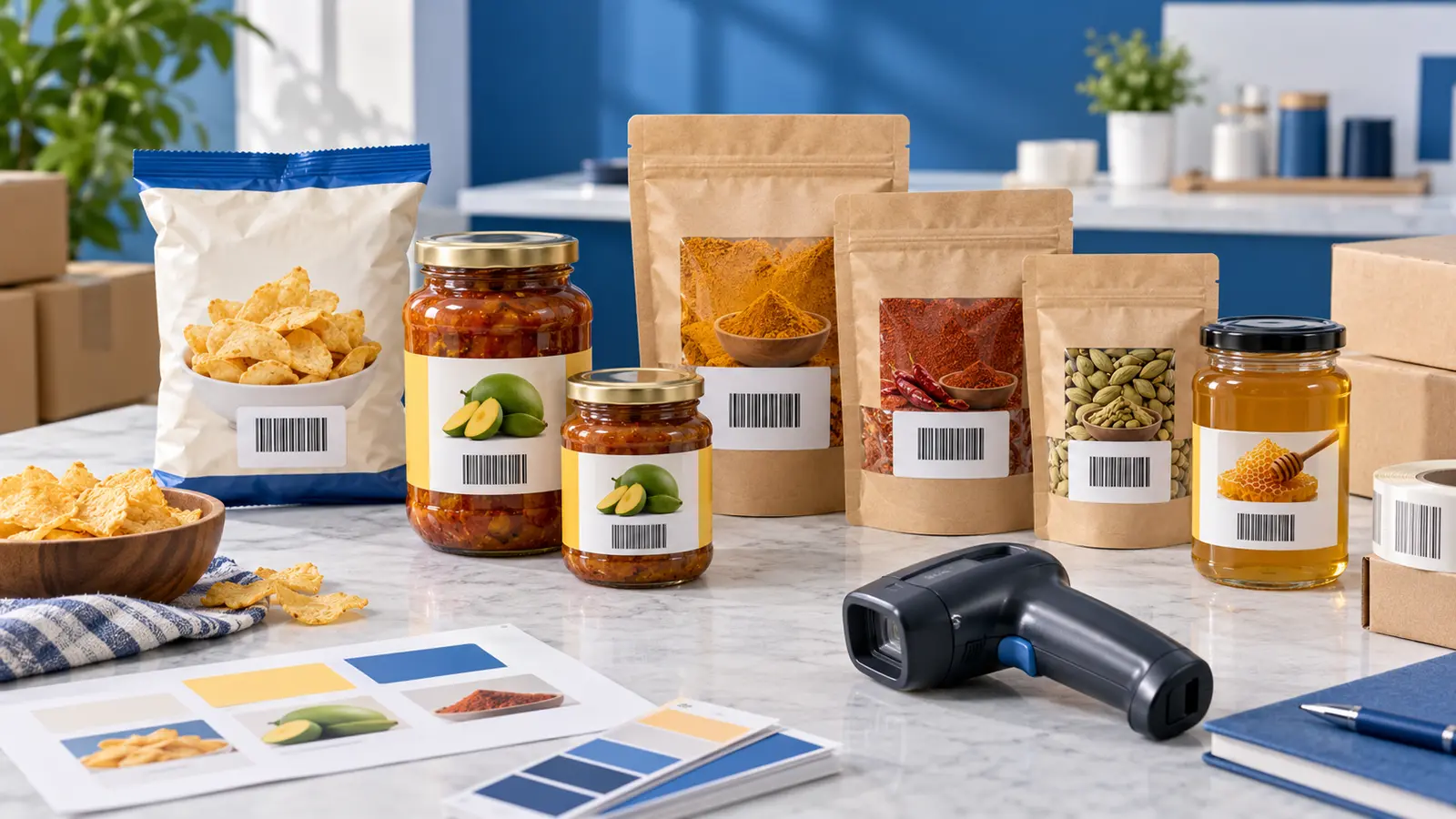
A food business can start with one recipe and quickly develop a surprisingly complicated product catalogue.
Your mango pickle may be sold in 250 g, 500 g and 1 kg jars. Your spice range may include five products, each available in two weights. Your snack brand may offer individual packets, family packs and assorted multipacks.
Every version may look like part of the same product family, but retailers and inventory systems need to distinguish what is actually being sold.
That is where careful planning for a barcode for food products in India becomes important.
This guide explains how food brands can organise their product variants, choose the appropriate barcode route, prepare packaging artwork and avoid common mistakes before printing thousands of labels or pouches.
Barcode for Food Products in India: The Short Answer
A food brand should begin by listing every product version that can be ordered, stocked or sold separately.
Differences such as these can create separate sellable variants:
- flavour,
- weight or volume,
- product formulation,
- pack quantity,
- individual pack versus multipack, and
- standard versus special product editions.
Each distinct sellable variant generally needs to be considered separately when planning product identifiers.
Before obtaining barcodes, also check what your intended supermarkets, independent stores, marketplaces, distributors or export customers require. Different trading partners can apply different product-identification and registration policies.
What Does a Barcode Do on Food Packaging?
An EAN-13 barcode usually presents a 13-digit product identifier in a machine-readable form.
When the barcode is scanned, a compatible retail or inventory system reads the number. The retailer's database can then associate that number with information such as:
- brand and product name,
- flavour,
- pack size,
- selling price,
- inventory quantity, and
- other product records maintained by the retailer.
The barcode itself should not be confused with the complete food label. It does not replace the statutory declarations, licences or other packaging information that may apply to a food business.
Food brands should review the current requirements of the Food Safety and Standards Authority of India and obtain appropriate professional guidance for their products.
Does Every Food Product Need a Different Barcode?
Think about the product that a shop or customer is actually ordering.
If two packages need to be distinguished during ordering, billing, storage or stock control, they should normally be treated as different sellable variants when you plan your barcode requirement.
Consider a honey brand selling:
- Wild Forest Honey – 250 g,
- Wild Forest Honey – 500 g,
- Mustard Honey – 250 g, and
- Mustard Honey – 500 g.
This is not simply two products from an identification perspective. It is four separately sold flavour-and-size combinations.
For a complete method of calculating quantities across a larger catalogue, read How Many Barcodes Does Your Brand Need?
Different Weights and Volumes
A change in weight or volume creates a product that customers and retailers need to distinguish.
For example:
- Turmeric Powder – 100 g,
- Turmeric Powder – 250 g, and
- Turmeric Powder – 500 g
are three separately sold packs.
They may contain the same turmeric powder, but they have different quantities, packaging, prices and inventory records. Food brands should therefore include all three when calculating their product identifiers.
Different Flavours and Formulations
Different flavours should also be counted separately when customers can choose between them.
Suppose a snack brand sells 100 g packets in three flavours:
- Classic Salted,
- Masala, and
- Chilli Lemon.
That creates three sellable variants.
If every flavour is also available in a 250 g pack, the catalogue becomes:
3 flavours × 2 sizes = 6 sellable variants.
The same principle applies to different recipes or formulations, including sugar-free, low-sodium, organic or fortified versions when they are separately sold products.
Individual Packs, Multipacks and Combo Packs
Pack configuration is another area where food businesses can underestimate their requirements.
Imagine a biscuit company sells:
- one 100 g packet,
- a pack containing three 100 g packets, and
- a pack containing six 100 g packets.
These are different retail configurations. A customer purchasing a six-pack is buying a different sellable unit from someone purchasing one packet.
A mixed-flavour gift box or festival hamper sold as one complete unit may also need to be treated separately from the individual products inside it.
Do not simply reuse the barcode belonging to one item inside the box as the identifier for the complete multipack.
Do New New Batches or Expiry Dates Need New Barcodes?
A routine new manufacturing batch does not normally turn an unchanged product into a new retail item.
If a business produces the same 500 g packet again with the same product characteristics and pack configuration, the new batch or expiry date is generally managed separately from the retail product identifier.
However, a meaningful change in formulation, quantity or pack configuration may affect the product's identity.
When changing an established product, check the applicable allocation rules and the requirements of your trading partners before deciding whether to retain or replace its identifier.
Does a Packaging Redesign Need a New Barcode?
A visual redesign by itself does not necessarily create a different product.
Changing the colour scheme, product photography or typography while keeping the product, quantity and pack configuration unchanged may not require a new identifier solely because the artwork changed.
The situation can be different if the redesign accompanies a change such as:
- a new pack size,
- a changed recipe,
- a different quantity,
- a new flavour, or
- a different retail pack configuration.
Keep artwork changes and product-identity changes separate when reviewing your catalogue.
Check Where You Plan to Sell
Before buying barcodes or approving packaging, make a list of your intended sales channels.
These may include:
- your own website,
- local grocery stores,
- independent food retailers,
- supermarkets and organised retail chains,
- online marketplaces,
- quick-commerce platforms,
- distributors and wholesalers, and
- international buyers.
Ask each important trading partner what identification arrangement it accepts. If a retailer, marketplace or distributor requires identifiers from a specific system or registration in your company's name, follow that requirement.
A barcode option should be chosen according to where the product will be sold, not only according to price or delivery speed.
How to Prepare Barcodes for Food Packaging
1. Create a product-variant sheet
List each product using fields such as:
- brand,
- product name,
- flavour,
- weight or volume,
- pack quantity,
- internal SKU, and
- intended sales channels.
This sheet will help prevent two variants from accidentally receiving the same number.
2. Confirm sales-channel requirements
Check requirements before purchasing identifiers or sending packaging to print. This is particularly important when approaching large retail chains, marketplaces or export customers.
3. Obtain the appropriate product identifiers
Choose the identification route that meets your trading partners' requirements.
If you have confirmed that a one-time-purchase EAN-13 solution is appropriate for your intended channels, you can review the available YesBarcode EAN-13 barcode packages.
4. Maintain a master barcode register
Once a number has been assigned, record it permanently against the correct product variant.
A useful register may include:
- EAN-13 number,
- product and variant,
- pack size,
- SKU,
- assignment date,
- packaging version, and
- current product status.
Do not rely on email threads or WhatsApp messages as your only assignment record.
5. Give your designer proper artwork
Use the supplied high-resolution or vector artwork rather than a screenshot. YesBarcode currently provides JPG and SVG files together with an Excel list of purchased barcode numbers.
SVG artwork is especially useful in professional packaging software because it can remain sharp when handled correctly.
6. Plan the barcode position
Food packaging presents practical challenges, including:
- curved jars and bottles,
- flexible pouches,
- metallic or reflective packaging,
- transparent label areas,
- seams and folds, and
- small packets with limited space.
The barcode should remain clear, correctly proportioned and surrounded by sufficient blank space. Avoid placing it across a fold, crimped seal or sharply curved area.
7. Test a physical sample
A barcode can look fine on a computer and still become difficult to scan after printing.
Test a production-quality packaging sample before approving a large print run. Check the barcode after the pouch, bottle, box or jar label has taken its final shape.
If a printed code is causing trouble, use the YesBarcode verification tool to check its 13-digit structure and then review the packaging issues covered in Why Is My Barcode Not Scanning?
Common Food-Barcode Mistakes
- Using one barcode for several weights of the same food.
- Forgetting to count each flavour separately.
- Reusing an individual packet's barcode for a multipack.
- Buying barcodes before checking retailer requirements.
- Treating a barcode as a replacement for required food-labelling information.
- Losing track of which number belongs to which product.
- Sending a screenshot to the packaging designer.
- Placing the barcode over a pouch fold or curved surface.
- Printing the full packaging order without testing a sample.
Frequently Asked Questions
Do food products need barcodes in India?
The practical requirement depends on where and how the food will be sold. Retailers, marketplaces, distributors and inventory systems may require product identifiers. Check each important sales channel before obtaining barcodes or printing packaging.
Does every flavour need a separate barcode?
If each flavour is sold, ordered or stocked separately, treat it as a distinct product variant when planning identifiers.
Does every food-pack size need a separate barcode?
Separately sold sizes such as 100 g, 250 g and 500 g are different retail variants and should generally be identified separately.
Does a multipack need its own barcode?
A multipack sold as one complete retail unit is a different pack configuration from the individual products inside it and should be included separately in your product-identification plan.
Do manufacturing batches need different barcodes?
A routine new batch of an otherwise unchanged product does not normally create a different retail product. Batch and expiry information are generally managed separately, subject to applicable requirements.
Can the same barcode be used in shops and online?
The same product identifier may be used across channels when the relevant trading partners accept it. Marketplaces and retailers can have different verification requirements, so confirm their current policies.
Where should a barcode be placed on food packaging?
Place it on a clear, relatively flat area where it will not be damaged, folded, stretched or obscured. The best position depends on the material and final shape of the package.
Can I test an EAN-13 number before printing?
Yes. The YesBarcode verification tool can check the 13-digit structure and recalculate the check digit. Structural verification is different from testing the physical print quality, so also scan a production-quality packaging sample.
Final Checklist for Food Brands
- List every flavour, weight, volume and pack configuration.
- Count separately sold variants.
- Check retailer, marketplace and distributor requirements.
- Choose the appropriate barcode route.
- Maintain a master assignment register.
- Use proper barcode artwork.
- Position the symbol carefully on the packaging.
- Test a physical sample before mass printing.
If a one-time-purchase EAN-13 solution is suitable for your food products and intended sales channels, compare YesBarcode packages from one barcode upwards.