
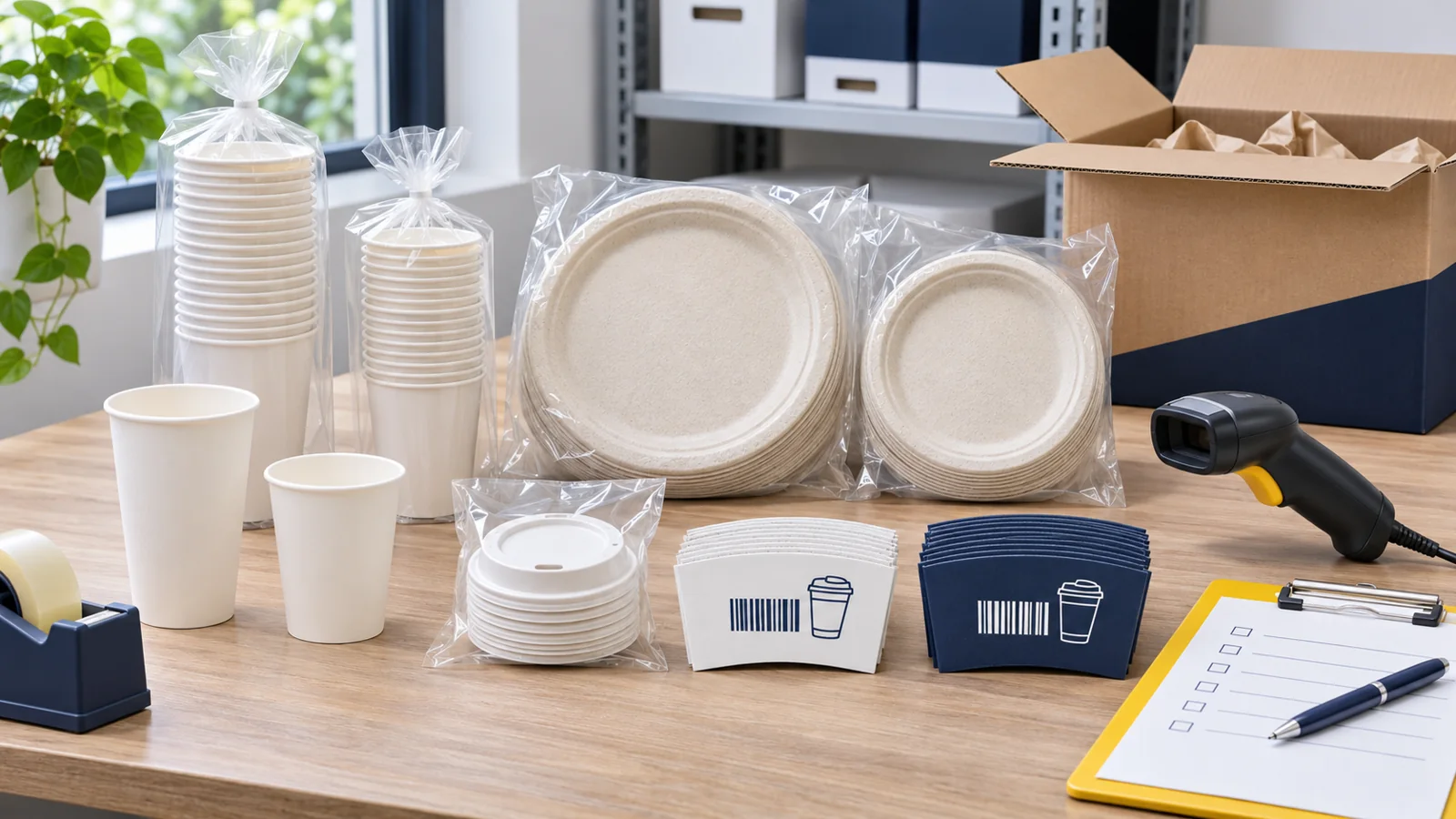
A shop orders 50-piece packs of paper cups. Your warehouse sends sleeves containing 100 cups because the products share the same name in the stock list. The cup itself is identical, but the retail offer is different.
That is where barcode planning earns its place. The identifier needs to point to the exact pack a buyer ordered, including the product specification and quantity inside.
This guide explains barcodes for disposable tableware in India, with examples for cups, plates, bowls, lids and fixed tableware packs. It focuses on product identification and packing accuracy. Confirm your intended buyer's identifier requirements before purchasing numbers or approving packaging.
Start With the Pack That Is Actually Sold
Count the products a customer or retailer can order separately. A cup, a sealed sleeve of cups and a traded case of sleeves are different packaging levels to review.
For most small brands, the useful starting question is: “What does one scan represent in this sales setup?” If the shop sells one sealed 50-cup pack, its record should describe that complete pack. Do not make the cashier work out how many individual cups are inside.
| Offer | Description to record | Error to prevent |
|---|---|---|
| Cup sleeve | Capacity, model and cups per pack | Picking a different capacity or count |
| Plate pack | Diameter, model and plates per pack | Confusing a small snack plate with a dinner plate |
| Lid pack | Lid model, compatible cup reference and quantity | Sending an unsuitable lid |
| Fixed tableware kit | Exact products and quantities in the kit | Substituting contents without approval |
| Traded case | Retail pack reference and packs per case | Treating a case as one retail sleeve |
A shipping carton used only to protect an order does not automatically become a separately traded product. Ask the buyer how cases are ordered and received, and agree any case-level identifiers and logistics labels separately.
Which Differences Need Separate Product Records?
Separately offered trade-item variants need distinct appropriate identifiers. For tableware, the differences can include size, capacity, material, model, colour or pack quantity.
Use precise descriptions rather than broad names such as “White Cup” or “Large Plate”. A record for “Paper cup, model C200, 200 ml, white, 50 pieces” is easier to match than a nickname known only to your production supervisor.
- Capacity: distinguish a 150 ml cup from a 200 ml cup.
- Dimensions: specify whether a plate measurement is its outside diameter.
- Construction or model: keep separately offered versions identifiable.
- Pack count: distinguish a 25-piece retail pack from a 50-piece pack.
- Included accessories: state whether lids or other pieces are included.
Only include combinations you actually sell. A range with two sizes does not necessarily have every colour and pack count in both sizes.
A Worked Example for a Small Brand
Imagine a confirmed launch range containing:
- Two cup capacities, each sold in 50-piece and 100-piece packs: 4 retail products.
- Two plate diameters, each sold in one 25-piece pack: 2 retail products.
- One matching lid model sold separately in a 50-piece pack: 1 retail product.
- One fixed physical kit containing a specified cup pack and plate pack: 1 additional retail product.
That is 8 distinct retail offers: 4 + 2 + 1 + 1. Review any separately traded cases in addition to these consumer packs.
Producing 2,000 identical 50-cup packs does not mean assigning 2,000 different retail product numbers. The same assigned identifier repeats across identical packs of that product. It identifies the trade item, rather than acting as an individual-pack serial number.
For the general counting method, use the guide to how many barcodes your brand needs.
Keep Lid Compatibility Separate From Barcode Identity
A barcode can help select a lid record, but it does not explain which cups that lid fits. Keep a compatibility field in the catalogue and confirm it against the actual products.
For example, do not describe a lid only as “for 200 ml cups”. Different cup models can require different lid specifications. Record the exact compatible model references and use approved samples when checking the fit.
If a cup-and-lid pack is sold as one fixed physical retail item, define the whole pack. Keep its contents and identifier distinct from separately sold cup and lid packs. This prevents a correctly scanned cup pack from being mistaken for the combined offer.
Give Fixed Kits a Clear Contents List
A fixed physical bundle needs its own appropriate trade-item identifier. A virtual promotion that discounts separately fulfilled items is a different arrangement; confirm how the platform or retailer handles it.
Write a packing specification for each physical kit. It should identify each component product, its quantity and the approved outer pack. “Party pack” is too vague if staff can choose different plate sizes or cup capacities.
Keep the full assembly and change-control procedure with your existing gift sets and multipacks guide. For tableware, the immediate task is ensuring that every sealed kit contains the exact combination described in its record.
Check Labels After Wrapping and Packing
Stacks of cups and plates can leave little flat space for a label. Transparent wrapping can wrinkle, while a sleeve may move during handling. Plan the barcode on the finished pack rather than assuming a flat artwork proof represents the final result.
- Choose an accessible panel, band or label with the printer.
- Keep the full symbol and its required clear space visible.
- Avoid seams, folds and sharply curved areas.
- Use a suitable light background behind dark bars.
- Test after wrapping, sealing and normal handling.
For a multipack, check whether another barcode can be read through the wrapping. The intended pack identifier should be clear in the actual checkout setup. Agree any packaging adjustment with the printer and buyer.
If the finished pack scans inconsistently, use the barcode troubleshooting guide. A routine scan test is useful, but it does not replace a formal print-quality verification report when the buyer requires one.
Maintain One Approved Product-and-Pack List
Keep the internal SKU, assigned number, exact product specification, pack count, photograph and approved artwork revision in one controlled list. Add case configuration and lid compatibility where relevant.
Before dispatching a new range, have someone compare a packed sample with that list. Scan it in the intended system and check that the displayed description matches both the product and the quantity. Reading a number successfully is only half the check.
Also keep product-identification work separate from claims about food contact, materials, compostability or environmental performance. A barcode does not certify those claims. Support any such statements through the appropriate evidence and product-specific review.
Prepare the Catalogue Before Ordering Barcodes
First settle the sellable packs, specifications and included accessories. Then confirm which identifier route and symbol format your retailers or sales platforms accept.
Where that route is suitable, review YesBarcode's current EAN-13 packages. The offering includes JPG and SVG artwork plus an Excel number list. Assign each number to the correct approved product record before sending artwork to the printer.
For a tableware range, clear pack descriptions are as useful as clear bars: the buyer should receive the right cup, the right lid and the right quantity every time.
Frequently Asked Questions
Do 50-piece and 100-piece cup packs need different barcodes?
Yes. They are different retail offers and need separate appropriate identifiers, even when the individual cups are identical.
Does every identical pack need a unique number?
No. The same assigned product identifier repeats across identical units of that pack. Individual-unit serialisation is a separate task.
Should different plate sizes share one barcode?
No. Separately offered plate sizes need distinct identifiers so buyers and stock systems can select the intended product.
Does a separately sold lid pack need its own record?
Yes. Identify it as its own trade item and record the exact compatible cup models separately.
Can a tableware kit use the cup pack's barcode?
A fixed physical kit needs its own appropriate identifier. The cup pack's number identifies that component, not the complete kit.
Does a barcode certify that tableware is food-safe or compostable?
No. A barcode identifies a product. Safety and environmental claims require their own supporting evidence and applicable review.