
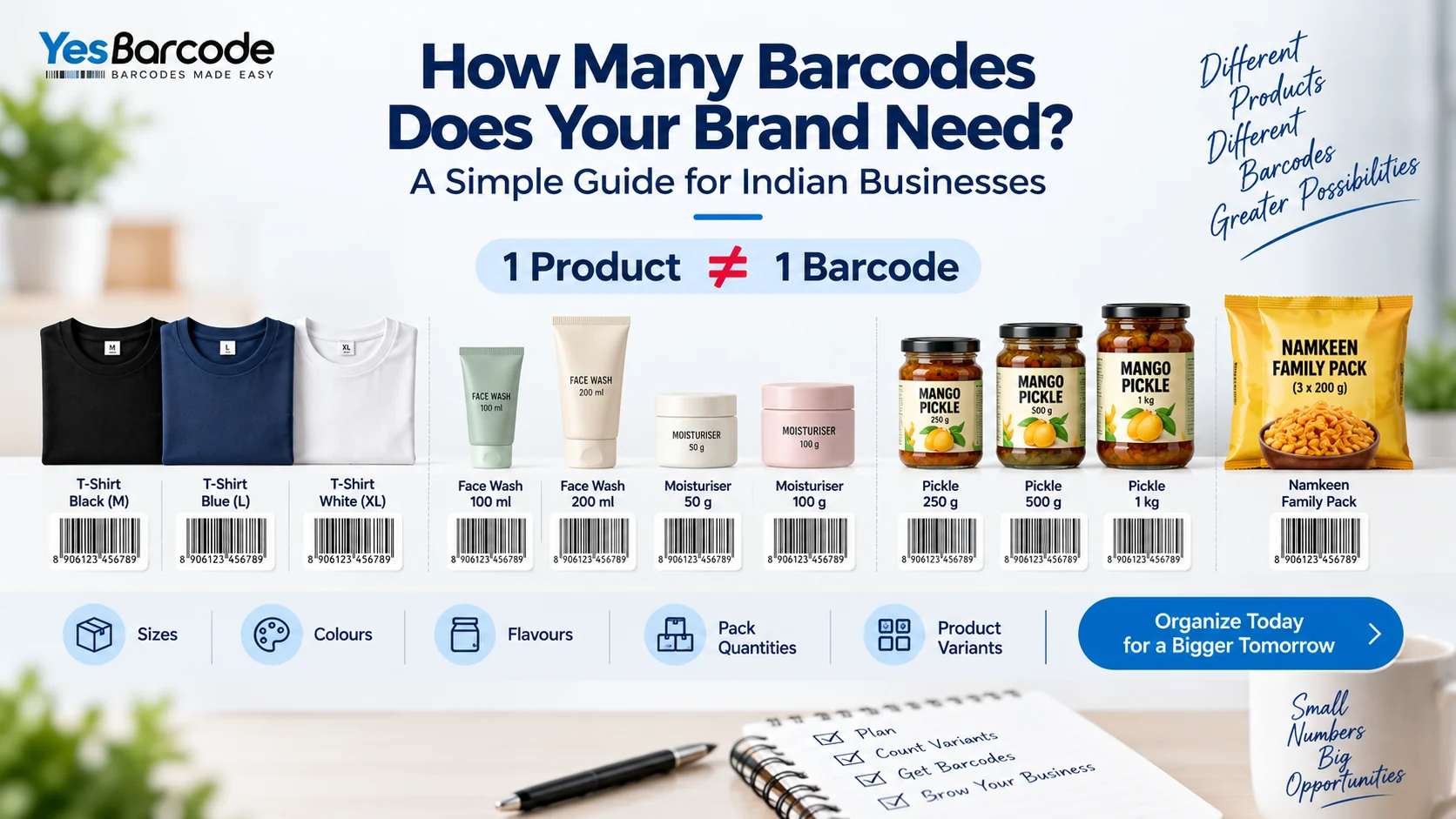
You may have 10 products in your catalogue, but that does not necessarily mean you need 10 barcodes.
You might need 10. You might need 50. In some businesses, you could need several hundred.
The reason is simple: when calculating your barcode requirement, you need to think about individual sellable product variants, not just product names.
A T-shirt available in five sizes and four colours is not one item from a product-identification perspective. A 250 g jar and a 500 g jar of the same pickle are not the same sellable variant either.
So before ordering EAN-13 barcodes, it is worth spending a few minutes mapping your actual product range.
This guide will show you how.
The Simple Rule: Count Your Sellable Product Variants
A useful starting point is:
If two versions of a product need to be distinguished when they are sold, stocked or ordered, treat them as separate variants when calculating your barcode requirement.
Differences that can create separate sellable variants include:
- Size
- Colour
- Weight
- Volume
- Flavour
- Fragrance
- Pack quantity
- Product formulation
- Separately sold multipacks
That means the number of barcodes your business needs can be very different from the number of product names in your catalogue.
One Product Can Need More Than One Barcode
Let's start with a very simple example.
Imagine you sell honey under one product name:
Pure Natural Honey
It is available in three pack sizes:
- 250 g
- 500 g
- 1 kg
From a marketing perspective, you may think of this as one product.
From a retail and inventory perspective, however, these are three separately sold variants.
You would therefore generally plan for:
3 pack sizes = 3 product identifiers
This distinction is the foundation of calculating your barcode requirement correctly.
A Quick Test to Identify Separate Variants
There is a practical question you can ask whenever you are unsure:
If a customer ordered Product A and received Product B instead, would they consider it the wrong item?
If the answer is yes, the two products probably need to be distinguished in your product records.
For example, if someone orders a 500 ml bottle and receives a 250 ml bottle, it is clearly not the same item.
If someone orders a medium black T-shirt and receives an extra-large blue T-shirt, the difference is equally obvious.
This simple test makes complicated catalogues much easier to understand.
Example 1: How Many Barcodes Does a Food Brand Need?
Suppose you run a pickle brand with three flavours:
- Mango
- Lime
- Mixed
Each flavour is sold in two sizes:
- 250 g
- 500 g
Your calculation is:
3 flavours x 2 sizes = 6 sellable variants
So you would generally plan for six separate product identifiers.
Now imagine you introduce a 1 kg mango pickle.
You have created another sellable variant, bringing the total to seven.
If you later introduce 1 kg packs for lime and mixed pickle as well, your catalogue becomes:
3 flavours x 3 sizes = 9 variants
This is why it helps to think about your upcoming launches before deciding how many barcode numbers your business is likely to require.
Example 2: How Many Barcodes Does a Clothing Brand Need?
Apparel is one of the easiest industries in which to underestimate barcode requirements.
Suppose you launch one T-shirt design in:
- Black
- White
- Blue
- Red
And every colour is available in:
- Small
- Medium
- Large
- XL
- XXL
The calculation is:
4 colours x 5 sizes = 20 variants
That means one T-shirt design can create 20 separately identifiable combinations.
Now suppose your new collection contains 10 designs with the same colour-and-size structure.
Your requirement could become:
10 designs x 4 colours x 5 sizes = 200 variants
A fashion company can therefore move from a relatively small product range to hundreds of variants very quickly.
Example 3: How Many Barcodes Does a Cosmetics Brand Need?
Imagine a skincare business with the following products:
- Face Wash - 100 ml
- Face Wash - 200 ml
- Moisturiser - 50 g
- Moisturiser - 100 g
- Serum - 30 ml
You have five separately sold variants.
Now the brand introduces a gift set containing selected products as one separately sold package.
The gift set itself is another trade item.
So your requirement becomes:
5 individual variants + 1 gift set = 6 sellable variants
If travel-size products inside the gift set are also sold separately, those separately sold travel sizes may add further variants.
Example 4: How Many Barcodes Does a Snack Brand Need?
Suppose your company sells namkeen in three flavours:
- Classic
- Spicy
- Masala
Each flavour comes in:
- 50 g
- 200 g
- 1 kg
The calculation is:
3 flavours x 3 sizes = 9 variants
Now suppose each flavour is also available as a family pack containing three 200 g packets.
Those three family packs are separately sold configurations.
Your total becomes:
9 individual variants + 3 family packs = 12 variants
Example 5: How Many Barcodes Does a Stationery Brand Need?
Suppose your notebook range is available in:
- Ruled and plain
- A4 and A5 sizes
- Three cover colours
The calculation is:
2 page styles x 2 sizes x 3 colours = 12 variants
Again, what looks like one notebook range from a marketing perspective can contain 12 different sellable combinations.
What If Your Business Has Only One Product?
Not every business needs dozens or hundreds of identifiers.
Suppose your startup sells:
- One product
- One size
- One formulation
- One pack configuration
Your initial requirement may simply be one product identifier.
The correct quantity depends on your catalogue. There is no reason to make the calculation more complicated than it needs to be.
Does Every Product Size Need a Different Barcode?
If the different sizes are separately sold variants, they generally need to be identified separately.
For example:
- Shampoo - 100 ml
- Shampoo - 250 ml
- Shampoo - 500 ml
These are three different trade items.
A customer purchasing 500 ml is buying something different from a customer purchasing 100 ml, even though the brand and product formulation may be the same.
Does Every Colour Need a Different Barcode?
If colour creates a separately sold variant, you should generally treat each colour-and-product combination separately.
For example:
- Water Bottle - Black
- Water Bottle - Blue
- Water Bottle - Pink
If customers select these colours individually and your inventory tracks them separately, they are distinct variants.
For apparel, footwear, accessories and similar categories, combining colour and size can increase the number of variants quickly.
Does Every Flavour Need a Different Barcode?
If flavours are independently sold, they are different product variants.
A strawberry protein bar and a chocolate protein bar are not interchangeable from the customer's point of view.
The same applies to:
- Food flavours
- Beverage flavours
- Fragrances
- Cosmetic shades
- Different formulations
Does a Different Pack Quantity Need Its Own Barcode?
Pack configuration is another area businesses sometimes overlook.
Suppose you sell the same soap as:
- Single bar
- Pack of 3
- Pack of 6
These are different sellable configurations.
The customer purchasing six soaps is buying a different retail item from someone purchasing one soap.
Separately sold multipacks should therefore be included when you calculate the number of identifiers your catalogue requires.
Does a New Manufacturing Batch Need a New Barcode?
A routine new manufacturing batch does not automatically turn the product into a different trade item.
For example, if you manufacture the same 500 g packet in January and again in February with the same product characteristics, the manufacturing date alone does not necessarily create a new retail product identity.
Batch numbers, manufacturing dates and expiry information are typically managed separately from the retail product identifier.
Does Changing the Price Mean You Need a New Barcode?
A simple retail price change does not automatically mean you need a completely new product identifier.
Retailers commonly maintain selling prices separately within their systems.
However, product changes can become more complicated when packaging, quantity, formulation or another important product characteristic changes at the same time.
When making a substantial change to an existing product, check the applicable GTIN allocation rules before assigning or retaining an identifier.
What About Packaging Redesigns?
A minor visual redesign does not necessarily create a completely new trade item.
For example, changing colours, typography or the arrangement of graphics while keeping the actual product and quantity unchanged may not require a new product identity solely because the artwork changed.
But if the redesign accompanies a meaningful change in the product, quantity, formulation or pack configuration, the situation can be different.
When in doubt, verify the applicable identification rules before sending the new packaging to print.
Do You Need Different Barcodes for Amazon, Flipkart and Your Own Website?
You should not normally create a new product identity simply because the same trade item is being sold through another sales channel.
An identifier is intended to identify the trade item rather than the marketplace.
However, Amazon, Flipkart and other platforms can have their own rules about which identifiers they accept and how they verify them.
So there are two separate questions:
- How many unique trade items do I have?
- Which identifiers will my intended sales channels accept?
Answer both before printing your packaging.
Should You Buy Only the Number of Barcodes You Need Today?
It is useful to consider reasonable near-term growth before deciding on quantity.
Suppose you currently have 18 variants but already know that another 12 are being developed for launch over the next six months.
Planning only for today's 18 variants may mean repeating the purchasing and assignment process shortly afterwards.
A practical method is:
- Count every current sellable variant.
- Add confirmed or realistic upcoming variants.
- Consider the quantity that suits your expected catalogue.
Do not add hundreds of imaginary future products simply to make the number larger. Base the calculation on a realistic product roadmap.
You can compare the available EAN-13 quantities on the YesBarcode EAN-13 Barcode page.
Create a Barcode Master Sheet Before Assigning Numbers
Once you have more than a few variants, keeping everything in somebody's inbox or WhatsApp messages becomes risky.
Create one central spreadsheet before you begin assigning numbers.
A simple structure could look like this:
| Product | Variant | SKU | EAN-13 | Status |
|---|---|---|---|---|
| Mango Pickle | 250 g | MP250 | Assigned Number | Active |
| Mango Pickle | 500 g | MP500 | Assigned Number | Active |
| Lime Pickle | 250 g | LP250 | Assigned Number | Active |
| New Product | Planned | Pending | Unassigned | Planned |
You can add other useful fields such as:
- Date assigned
- Product category
- Pack size
- Marketplace listing status
- Packaging version
- Internal notes
The purpose is simple: every identifier should have a clear relationship with the product to which it has been assigned.
A Simple Formula for Calculating Your Barcode Requirement
For products with several attributes, multiplication is often the easiest way to estimate your variant count.
For example:
Number of designs x number of sizes x number of colours = number of variants
For a food product:
Number of flavours x number of pack sizes = number of variants
Then add separately sold bundles, multipacks or other configurations.
This approach turns what initially looks like a complicated catalogue into a straightforward calculation.
Common Mistakes When Calculating Barcode Requirements
Before placing an order, watch out for these common mistakes:
Counting Product Names Instead of Variants
"T-shirt A" may represent 20 separately sold colour-and-size combinations.
Forgetting Multipacks
A pack of six sold as one retail unit is different from a single unit.
Forgetting Upcoming Products
If new variants are already confirmed for launch, include them in your planning.
Assuming Every Marketplace Needs a New Number
The same trade item does not normally become a different product simply because it is sold through another channel. Marketplace acceptance rules are a separate consideration.
Assigning Numbers Without Keeping Records
As your catalogue grows, undocumented assignments can create unnecessary confusion for packaging, inventory and e-commerce teams.
Frequently Asked Questions
How many barcodes does a new business need?
There is no fixed number. Count the individual product variants you intend to sell. A single-product business may initially need only one identifier, while a clothing or cosmetics brand can require dozens or hundreds.
Do I need one barcode for every SKU?
SKU and product-identification systems serve different purposes, so they should not automatically be treated as identical concepts. However, separately sold variants that your business tracks as distinct products will commonly require separate product identifiers.
Do different sizes need separate EAN-13 barcodes?
If the sizes are separately sold trade items, they should generally be identified separately. A 250 g product and a 500 g version are not the same sellable variant.
Do different colours need separate barcodes?
If customers purchase the colours as separate variants, they should generally be treated as separately identifiable trade items.
Does every flavour need a different barcode?
Separately sold flavours are different product variants. Chocolate, strawberry and vanilla versions should therefore be included separately when calculating your requirement.
Does a pack of three need a different barcode from a single product?
If the pack of three is sold as a separate retail configuration, it is a different trade item from the individual unit and should be included separately in your product-identification planning.
Do I need another barcode for the same product on another marketplace?
A trade item does not normally become a new product simply because it is sold on another marketplace. However, each marketplace can have its own acceptance and verification requirements for product identifiers.
Can I buy extra EAN-13 barcodes for future products?
You can plan your requirement around your current catalogue and realistic upcoming launches. Keep unassigned numbers clearly marked in your master records until you are ready to allocate them.
Final Thoughts
Calculating how many barcodes your brand needs becomes much easier once you stop counting product names and start counting sellable variants.
A product available in three sizes may represent three variants. Add four colours and the same range can become 12. Add several designs and the number can grow quickly.
Before purchasing, create a complete list of your products and variations. Include sizes, colours, flavours, weights, pack quantities and separately sold multipacks.
Then consider the products you realistically expect to launch in the near future.
Finally, maintain a central record as you assign each number.
A little organisation at the beginning can make packaging, inventory management and future catalogue expansion considerably easier.
Need EAN-13 Barcodes for Your Product Range?
Once you have calculated the number of sellable variants in your catalogue, you can choose an EAN-13 quantity that suits your requirements.
Already have an EAN-13 number you want to check?
Need to connect your packaging or printed material to editable online content?