
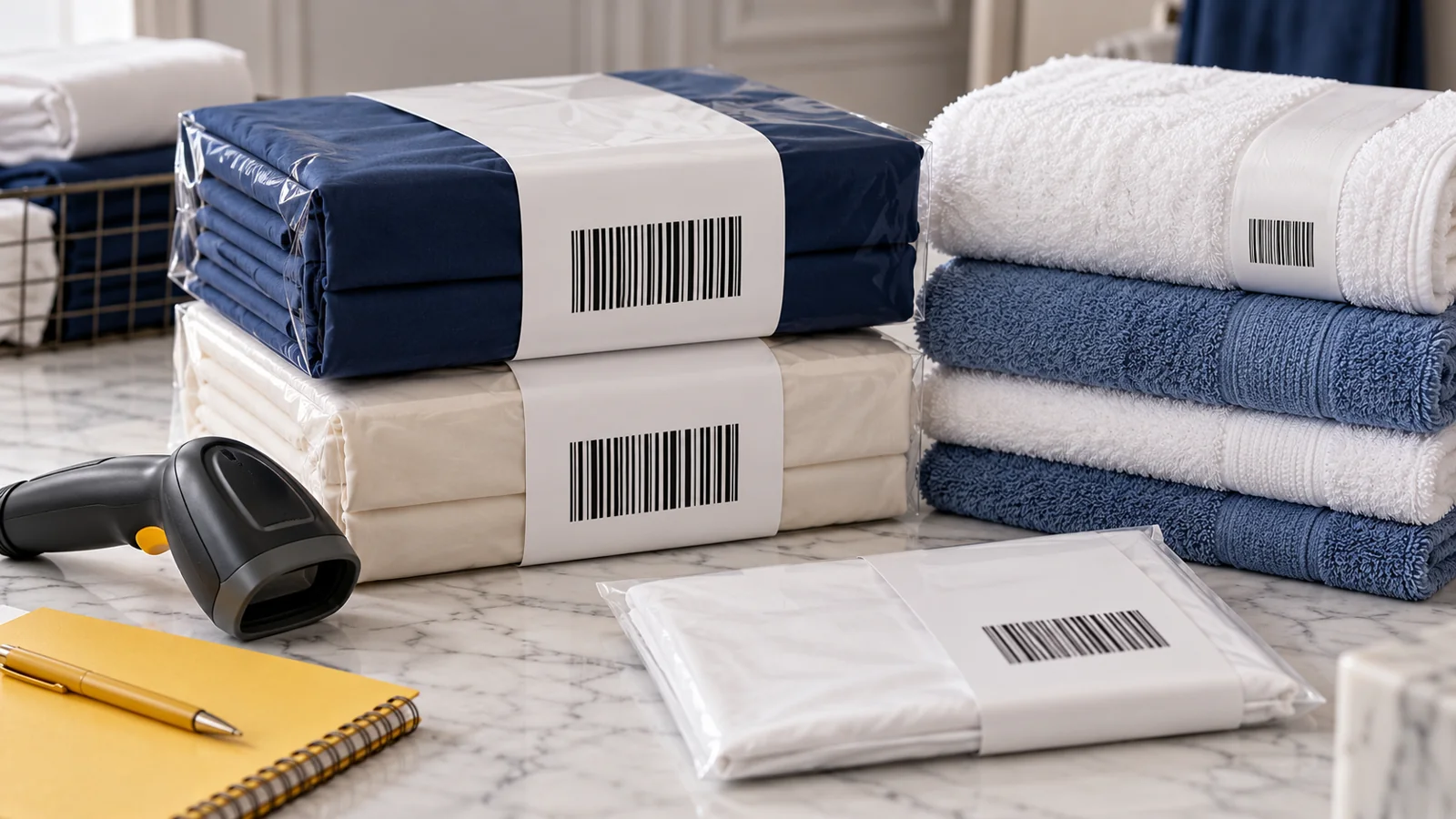
Your bedsheet collection has three prints, two sizes and an option with matching pillowcases. The towels come in four colours, with single pieces and coordinated sets. A stockist asks for the barcode list before placing an order.
Where do you start?
Plan the identifier around the exact retail pack: its design, size, material where relevant, and contents. Identical packs of the same defined variant share a product identifier; different sellable versions need to remain distinguishable.
This guide explains barcodes for bedsheets and towels in India, helping small home-textile brands prepare their product list before buying numbers or printing packaging.
Describe the Pack, Not Just the Collection
“Cotton Comfort” might be a useful range name, but it does not tell the warehouse which item to pick.
A clearer description would be “Cotton Comfort, Blue Stripe, Double Flat Sheet, One Sheet and Two Pillowcases”. Record the approved dimensions in separate fields as well.
For towels, “Blue Towel” may describe a hand towel, bath towel or bath sheet. Use a consistent product type, size and colour in the stock record and packaging artwork.
The barcode should select that defined record. It should not be expected to correct an incomplete description.
Separate Sizes, Colours and Selectable Prints
Official identification guidance assigns separate product identifiers to distinct size-and-colour combinations. Apply the same catalogue discipline to separately selected textile designs: a customer ordering blue stripes should not receive beige checks.
Suppose one bedsheet range offers:
- Three selectable prints: blue stripe, beige check and grey geometric.
- Two approved sizes: single and double.
- The same defined pack contents within each size.
If every combination is sold, that creates six variants. Printing 50 identical packs of each produces 300 packs, but still only six retail variants to identify.
Count the combinations that actually exist. If one print is unavailable in double size, remove that combination rather than assuming the full matrix is stocked.
Record Dimensions Alongside Size Names
Names such as single, double, queen and king may not communicate enough detail for your particular range.
Store the approved sheet dimensions and pillowcase dimensions with the size name. If you sell fitted sheets, include the relevant fitted dimensions and depth specification in the product information.
A flat sheet and a fitted sheet should not share one catalogue identity merely because both are described as “double”. They are different offers to the customer.
For towels, keep the dimensions linked to the type. Your team should be able to distinguish a hand towel from a bath towel without opening a sealed pack.
These fields are practical catalogue suggestions, not a complete statement of mandatory textile-labelling requirements.
Material and Quality Variants Need Clear Records
Two white bedsheets can look similar while belonging to different separately sold product lines.
If buyers choose between cotton and a cotton-blend version, or between defined quality grades, keep those products distinct. The same applies to towel ranges marketed and stocked separately by construction or specified weight.
Record the approved material and product specification. Avoid adding a claim such as thread count, fibre content or GSM simply because it appears on a supplier's generic image; the information must match the actual item.
A normal production variation within an unchanged specification is different from launching another retail variant. When changing an established product, review the applicable identification rules rather than treating every factory adjustment as a new product.
One Sheet, a Sheet Set and Pillowcases Are Different Offers
| Retail offer | Contents to define | Planning point |
|---|---|---|
| Bedsheet only | One approved sheet | Keep separate from a set containing pillowcases |
| Bedsheet set | One sheet and two specified pillowcases | Identify the complete fixed set |
| Pillowcase pair | Two pillowcases sold separately | Review as its own retail product |
| Single bath towel | One towel in the stated size and colour | Different offer from a multipack |
| Towel gift set | A fixed selection of towel types and quantities | Record and identify the complete set |
A fixed physical bundle sold as one trade item needs its own appropriate identifier, separate from those of its component trade items.
For example, a bath towel and hand towel sold individually are two products. Adding a fixed boxed set containing both creates a third retail offer. An online discount on two separately fulfilled products is a different arrangement.
For the complete set-handling workflow, read barcodes for gift sets and multipacks.
Be Clear About Assorted Packs
“Pack of three towels” does not tell the buyer whether the colours are fixed or selected at packing time.
If the customer chooses a particular combination, record the promised contents precisely. Do not silently substitute another colour while leaving the product description unchanged.
If the offer is genuinely assorted, agree on how it should be described and identified with the retailer. A changing assortment needs deliberate planning; it should not be created accidentally because staff use whatever stock is nearby.
Choose a Label Location That Survives Packing
Home textiles may be folded, wrapped, sleeved or boxed. Decide which presentation your buyer will scan.
A paper band around a folded towel can provide a scanning area, but test whether it stays secure during handling. For a sealed bedsheet set, check that the barcode remains visible on the finished pack rather than hidden under a flap or fold.
As practical approval checks:
- Keep the symbol and its required blank space clear.
- Check the effect of glossy or wrinkled wrapping.
- Match the readable size and contents description to the product.
- Scan the final packed sample, not only the artwork on screen.
- Obtain formal print-quality verification if the buyer requires it.
For detailed printing problems, use why a barcode may not scan.
Prepare One Approved Product-to-Barcode List
Before requesting printed bands or inserts, create a record for every confirmed retail variant. Include:
- Range and product type.
- Design or colour.
- Size name and dimensions.
- Approved material or quality specification.
- Exact pack contents.
- Internal SKU and assigned retail identifier.
- Artwork filename and approval status.
Use the same mapping when supplying the printer, packing team and retailer. During approval, scan a sample and confirm that the system selects the intended size, design and pack configuration.
Keep extra labels for similar-looking white or neutral products separated. If packaging is removed for display or a return arrives without its sleeve, check the actual item before reapplying a label.
Check Your Sales Channels Before Buying
Ask the stockist, marketplace or distributor which identifiers and registration arrangements it accepts for your category.
Do this before approving a large print run. A barcode that scans is not a guarantee of acceptance by every trading partner, and purchasing a number does not automatically create the item in a retailer's catalogue.
Once the route is confirmed, count the actual variants. For the wider calculation method, read how many barcodes your brand needs.
Getting Started With YesBarcode
If your intended channels accept the offered identifier route, compare YesBarcode's current EAN-13 packages. The published offering includes small quantities, JPG and SVG artwork, and an Excel number list.
Match each number to one confirmed product record, then share the approved artwork with your packaging supplier. Arrange physical bands, labels or inserts separately unless specifically agreed.
Build the list around what you sell, not the number of pieces you manufacture. A repeat run of identical packs does not mean buying a different retail product number for every pack.
Frequently Asked Questions
Do bedsheets and towels need barcodes in India?
The practical requirement depends on the sales channel. Confirm what your retailer, marketplace or distributor requires before purchasing identifiers.
Can single and double bedsheets share one barcode?
Separately sold sizes need distinct product identifiers so the correct version can be ordered, stocked and fulfilled.
Do different selectable prints need separate records?
Yes. If the customer orders a particular design, the record and identifier should distinguish that sellable variant.
Can a sheet-only pack and a sheet set share one identifier?
No. Different contents create different retail offers. Identify the approved sheet-only pack and the fixed set separately.
Does each identical towel need a unique retail barcode number?
No. Identical units of the same defined variant share its product identifier. Individual-unit tracking is a separate requirement.
Can the barcode go on a paper sleeve?
A sleeve can be suitable if the buyer accepts it and it remains secure and readable. Test the finished packed item.
Approve the Pack Before Printing the Range
Check one physical sample against its product record, contents list and printed identifier. Repeat that check for the versions most likely to be confused.
When your catalogue and buyer requirements are confirmed, choose the suitable YesBarcode package and give your printer the final product-to-barcode mapping.