
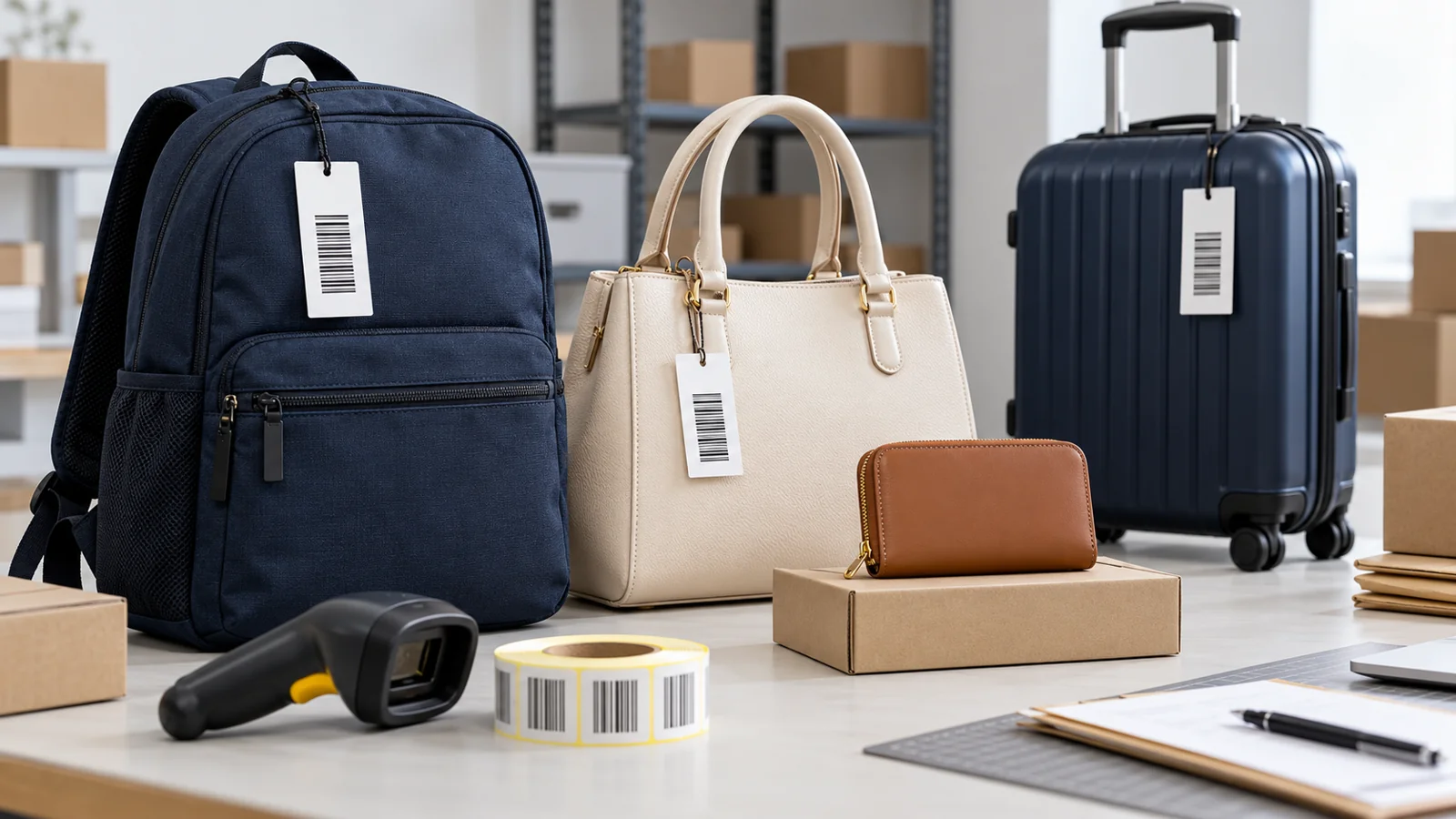
A retailer likes your new backpack collection and asks for a product list with barcodes. You have one design, three colours and two capacities. Should the whole collection share a number?
No. Separately sold versions need to remain distinguishable. Plan the identifier for the exact bag a customer can order, then connect it to the correct tag and catalogue record.
This guide explains barcodes for bags and luggage in India, with examples for backpacks, handbags, wallets, suitcases and fixed travel sets. It is designed for brands preparing their range for stockists, distributors or online sales.
Start With the Bag's Full Identity
A collection name is useful for marketing, but rarely identifies one stocked item completely.
For example, “Metro Backpack” might describe several products. A working description could be “Metro Backpack, Navy, 20 L, Model M20”.
Record the features that distinguish what the buyer receives:
- Model or style.
- Colour.
- Size, capacity or relevant dimensions.
- Material or finish where separately selectable.
- Included accessories.
- Single item or fixed retail set.
Not every internal manufacturing detail creates a new retail product. Focus on the versions that customers and trading partners must distinguish, and review applicable allocation rules when an existing product changes.
Do Different Colours and Sizes Need Different Barcodes?
Official identification guidance assigns different product identifiers to separately sold size-and-colour combinations. Identical units of the same defined variant share the assigned identifier.
Suppose the Metro Backpack is available in:
- Black, navy and grey.
- 20 L and 30 L capacities.
If all combinations are sold, that produces six variants: three colours multiplied by two capacities.
If the grey 30 L version does not exist, do not count it. Your launch list would contain five variants. Build the list from actual products rather than every theoretical combination.
For broader catalogue calculations, read how many barcodes your brand needs.
Use Precise Luggage Sizes
Suitcase descriptions such as “small”, “medium” and “large” can become confusing when suppliers, warehouses and customers use different naming systems.
Keep your model and approved size description together. If the product specification includes dimensions, record them in dedicated fields instead of relying only on a short tag name.
For example, a cabin-size suitcase and a larger checked-luggage model should not share an identifier merely because both belong to the same collection and colour.
Also avoid turning “cabin size” into an unsupported promise of acceptance by every airline. Barcode planning identifies the product; airline baggage allowances are a separate question.
Keep Different Bag Formats Separate
| Product | Example distinction | What to record |
|---|---|---|
| Backpack | 20 L versus 30 L | Capacity, model and colour |
| Handbag | Shoulder bag versus crossbody | Style, material, colour and included strap |
| Wallet | Standard version versus separately sold gift presentation | Model and exact retail configuration |
| Suitcase | Small versus large | Model, approved size and colour |
| Travel set | Two-piece versus three-piece set | Complete fixed contents |
A matching material or collection name does not make these products interchangeable. A retailer replenishing a navy crossbody bag needs a record that will not select a navy backpack.
Check What Is Included With the Bag
Accessories can make two similar-looking offers different.
Consider a laptop bag sold on its own and a separately marketed kit containing that bag plus a matching organiser. Describe each offer clearly and assess its identifier separately.
A spare strap sold independently is another product to review. It should not inherit the identifier of the complete handbag.
Equally, do not create extra retail numbers for every component that is simply part of the standard bag. Start with the actual retail offer and confirm any uncertainty with your trading partner.
Does a Luggage Set Need Its Own Barcode?
A fixed physical set sold as one trade item needs an appropriate identifier separate from those of its component trade items. A virtual online offer, fulfilled as separate items, is a different arrangement.
Suppose you sell three suitcase sizes individually in one colour. Those are three defined products. Adding a fixed three-piece set creates a fourth retail offer to identify.
Write down the exact contents of the set. “Small, medium and large suitcases, navy, Model T” is clearer than “Navy luggage combo”. If a customer buys the set, the scanned record should describe the set rather than one suitcase inside it.
For assembly and checkout handling, use the dedicated guide to barcodes for gift sets and multipacks.
Plan the Tag Around the Selling Unit
A bag may have a swing tag, a protective sleeve, a dust bag and a shipping carton. Decide which presentation the retailer will receive and scan.
A swing tag can be practical on a displayed backpack. A wallet sold in a closed gift box may need an accessible barcode on that retail box. Confirm the arrangement with the buyer.
As practical checks:
- Keep the barcode away from tag holes, folds and attachment points.
- Make the printed model, colour and size easy for staff to cross-check.
- Confirm that protective packaging does not hide the intended symbol.
- Check that an outer shipping label is not mistaken for the retail product barcode.
These are workflow suggestions, not a complete statement of mandatory product-labelling requirements.
Check the Bag, Tag and Product Record Together
A readable barcode on the wrong colourway can create a fulfilment problem even when scanning works perfectly.
Before releasing a tag order, compare three things side by side:
- The physical bag, including its model and variant.
- The approved tag with its assigned barcode number.
- The matching product entry in your catalogue or stock system.
Then scan a sample and verify which record opens. Use the final tag material and packed presentation rather than a large image on a screen.
Keep approved label files organised by SKU. If tags are detached for photography or display, reattach them only after checking the exact product. Do the same for returned stock.
For problems decoding the physical symbol, use the barcode print-troubleshooting guide.
Confirm Your Sales Channels Before Purchasing
A local stockist, a marketplace and an export distributor may have different product-ID onboarding requirements.
Ask which identifier source or registration arrangement the buyer accepts and what data it needs for each bag variant. Keep the response with your product launch records.
Do not assume that purchasing a barcode automatically registers the item with every sales platform. The product record, images, description and identifier must be submitted through the buyer's process.
Getting Your Bag Range Ready With YesBarcode
If your intended channels accept the offered identifier route, review YesBarcode's current EAN-13 packages. The published offering includes small quantities, JPG and SVG artwork, and an Excel number list.
Connect each supplied number to the exact bag variant in your assignment sheet. Share the approved artwork and mapping with your tag printer; arrange physical tag production separately unless specifically agreed.
A useful first order starts with a confirmed catalogue. Buying numbers before deciding the sizes, colours and set configurations can leave the designer working from an incomplete list.
Frequently Asked Questions
Do bags and luggage need barcodes in India?
The practical requirement depends on the sales channel. Confirm what your retailer, marketplace or distributor requires before buying identifiers or printing tags.
Can every colour of a backpack use the same barcode?
Separately sold colour variants need distinct product identifiers so orders and stock records can distinguish them.
Do different backpack capacities need different identifiers?
If capacities are sold as distinct variants, identify them separately. A 20 L version and a 30 L version should not be confused in the catalogue.
Do identical bags each need a different number?
No. Identical units of the same defined variant share its retail product identifier. Individual-unit tracking is a separate task.
Can I put the barcode on a swing tag?
A swing tag can work if it meets the buyer's requirements and stays accessible for scanning. Test it on the final product presentation.
Does a fixed luggage set need a separate identifier?
Yes. A physical set sold as one trade item needs its own appropriate identifier, separate from those of its component trade items.
Finish the Product List Before Printing Tags
Give every model, colour, size and fixed set an unambiguous place in the catalogue. Then approve the corresponding tag against a real sample.
Once the range and sales-channel requirements are confirmed, choose the suitable YesBarcode package and prepare the approved files for your printer.