
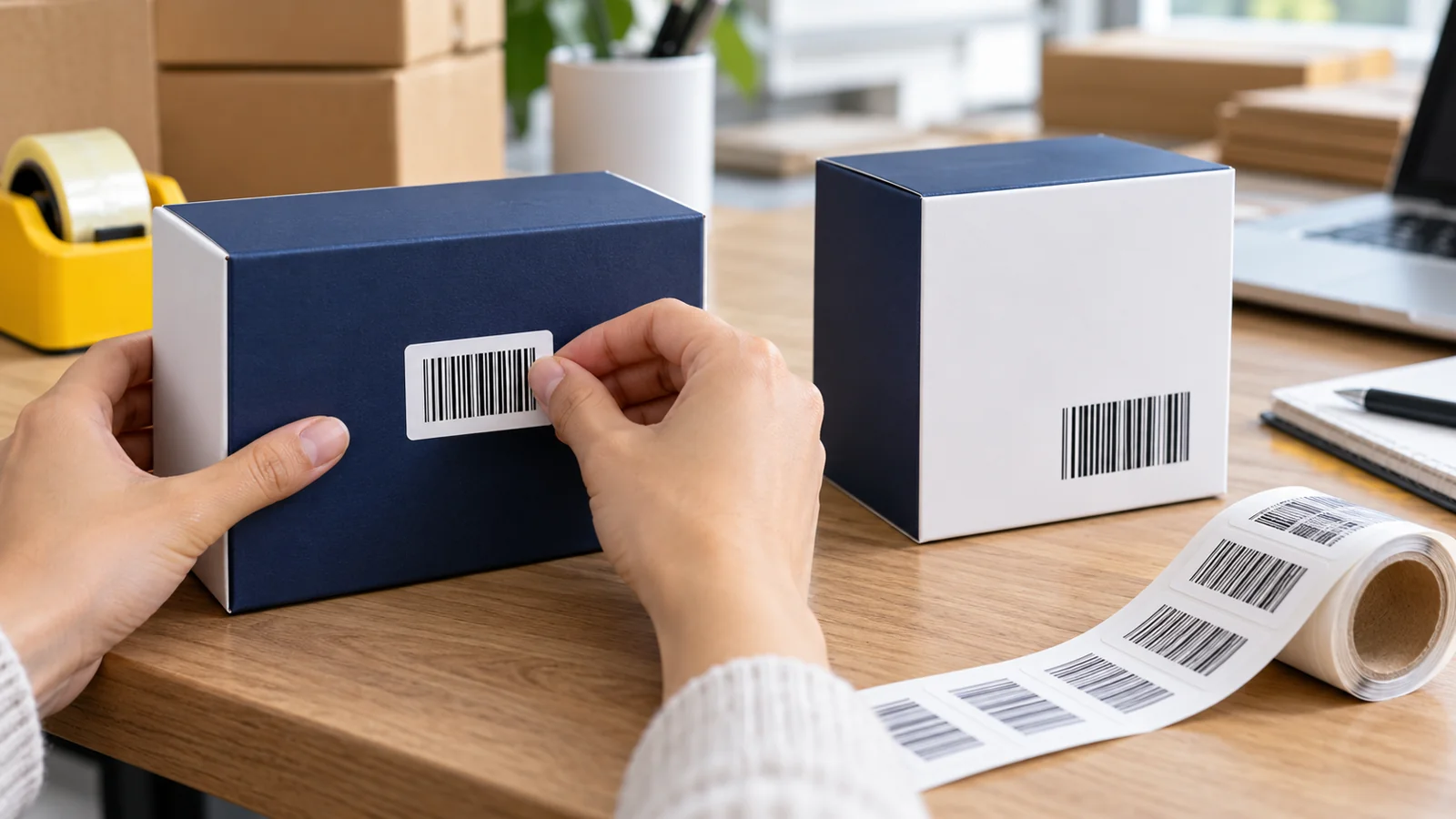
Your product is ready, but the packaging decision is still open. Should you add a barcode sticker to each pack or include the barcode in the printed design?
For a first launch, stickers can offer flexibility. For an established range, integrating the barcode into the artwork can remove a separate labelling step. Neither route is automatically the best choice for every business.
This guide compares barcode stickers vs direct printing by looking at the work involved, the packaging surface, likely changes and the full production cost.
The Short Answer
Choose the method that consistently puts the correct barcode on the correct product, survives normal handling and meets your buyer's requirements. Compare both routes using finished samples and supplier quotes.
Stickers are worth assessing when you use common packaging across several variants or need small quantities. Printing within the artwork is worth assessing when the design and product assignments are settled and you want fewer application steps.
GS1's implementation guidance recognises several application routes: incorporating the image in packaging artwork, using preprinted labels, and printing directly onto the pack on site. The method alone does not establish barcode quality or retailer acceptance.
What Does “Direct Printing” Mean Here?
Two different processes are often grouped under that phrase:
- Barcode in the packaging artwork: the symbol is printed along with the carton, pouch or other package design.
- On-site printing: suitable equipment prints the symbol directly onto the pack during production.
A third option is a printed product label that already includes the barcode. This still uses an applied label, but it may combine several pieces of information in one application.
Ask your supplier to describe the exact process. A quote for a barcode-only sticker is not directly comparable with a full product label containing the name, variant and barcode.
Compare the Operational Trade-Offs
| Decision | Separate barcode sticker | Barcode in packaging artwork |
|---|---|---|
| Application | Requires a separate labelling step unless combined with another label | No separate barcode-sticker application |
| Common blank packs | Can support a shared pack with controlled variant-specific labels | May require variant-specific artwork or a suitable on-demand process |
| Typical error to prevent | Applying the wrong label or omitting one | Printing the wrong identifier in an approved artwork file |
| Material check | Test the label, adhesive and printed surface together | Test the ink, substrate, finish and production process together |
| Change handling | Manage label stock and templates | Manage artwork versions and remaining packaging stock |
These are planning considerations, not promises of lower cost or better scanning. A well-controlled label process can work well, and an integrated symbol still needs careful approval.
When Stickers Are Worth Considering
Imagine a small brand launching three spice blends in identical plain cartons. The outer box design is shared, while a product label identifies the exact blend.
Including the correct barcode in that variant label could be more practical than keeping three separately printed carton designs. The trade-off is that the packing team must reliably match the label to the contents.
Before choosing this route, check whether:
- the label fits an accessible area of the finished pack,
- the label supplier can recommend a material and adhesive for that surface,
- the print remains readable through the expected handling conditions,
- your application process avoids wrinkles and misplaced labels, and
- your buyer accepts the proposed labelling arrangement.
If the product will be exposed to refrigeration, moisture, oils or abrasion, describe those conditions to the supplier and test them. “Permanent label” is not enough detail to approve a material for every surface.
When Integrated Printing Is Worth Considering
Now imagine a brand repeatedly ordering the same carton for an established 250 g coffee blend. Its product specification, identifier and artwork are settled.
Printing the barcode within that carton design can remove the separate task of adding a barcode-only sticker. It also shifts the approval responsibility upstream: the barcode must be correct before the cartons are produced.
Give the printer the approved artwork and exact product assignment. Ask for a production proof and agree on how changes will be controlled. A visually similar 500 g carton should not inherit the 250 g identifier simply because the designer duplicated the file.
If one carton design will be used for several products, discuss whether on-site printing or a combined product label is a better fit than fixed artwork.
Compare Total Cost, Not Just the Label Price
For stickers, request a quote covering the label stock, printing, delivery and any setup. Then account for your application time, inspection and realistic waste.
For integrated artwork, ask about setup, proofing, print quantity, lead time and the cost of unused packaging if a design changes.
Here is a hypothetical labour example:
If applying and checking each separate sticker takes 8 seconds, 1,500 packs require 12,000 seconds, or about 3 hours 20 minutes. At an illustrative labour cost of INR 120 per hour, that is INR 400 before labels, setup, breaks, rework or other costs.
These are example assumptions, not a supplier quote or industry benchmark. Time your own process with a trial batch. If labelling is automated or already part of another step, your calculation will differ.
Likewise, do not assume integrated printing always costs less. Compare actual quotes for the quantity and revision risk you expect.
Keep Product Identity Separate From the Printing Method
Moving an unchanged product's barcode from a sticker into its artwork does not, by itself, create a new trade item. Keep the correctly assigned identifier unless a separate product change requires a new one.
Do not buy another retail number just because you are reordering stickers or changing printers. First check whether the product itself has changed.
For changes involving quantity, formulation or pack configuration, use the dedicated guide on when you need a new barcode.
Approve a Finished Sample of Each Route
Ask both suppliers for a sample using the intended materials and dimensions. Then compare the final packs, not just the digital artwork.
- Compare the printed digits with the approved product record.
- Check the label application or integrated print after packing and sealing.
- Test the pack under its expected handling and storage conditions.
- Scan it with equipment representative of the receiving environment.
- Confirm the scanned number selects the correct product record.
- Obtain formal print-quality verification if your buyer or specification requires it.
Keep this article's decision focused on the production route. For detailed scan problems, refer to why a barcode may not scan.
Control the Handoff to the Packing Team
Whichever method you choose, prepare one approved reference showing the product name, variant, identifier and artwork or label-template revision.
For stickers, keep variant labels clearly separated and check the first completed pack before the rest of the run. When changing products, remove the previous job's loose labels from the work area.
For printed packaging, separate old and current revisions and check the first packed sample against the approved reference. Do not rely on carton colour alone to identify the right version.
These simple operational checks address a different problem from scan quality: a perfectly readable barcode can still belong to the wrong product.
How YesBarcode Fits Into the Process
If your sales channels accept the identifier route you have chosen, YesBarcode's current EAN-13 packages include JPG and SVG barcode artwork and an Excel number list. Share the appropriate supplied file with your designer or label printer and keep the product mapping with it.
Confirm physical label printing, materials and application separately with your supplier. Digital barcode artwork is not the same deliverable as a roll of finished stickers.
Before printing, the YesBarcode verification tool can check a 13-digit number's structure and check digit. It does not test label adhesion or grade the physical print.
Frequently Asked Questions
Can a retail barcode be printed on a sticker?
Yes. Applied labels are an established application method. The finished label must use the correct identifier, remain readable and meet the relevant buyer requirements.
Are stickers better than printing the barcode in the artwork?
Neither is universally better. Compare your packaging, quantities, application process, change frequency and finished samples.
Do I need a new number when I switch from stickers to printed packaging?
Not solely because the printing method changes. Review product identity separately and retain the assigned identifier for an unchanged trade item.
Which method is cheaper?
Use actual supplier quotes and include application labour, setup, inspection, waste and unused packaging. A low label price alone does not establish the lowest total cost.
Can I print labels using an office printer?
It may suit some jobs if the printer, label stock and output meet the application requirements. Test the finished pack and obtain any verification your buyer requires before scaling up.
Does a digital barcode purchase include physical stickers?
Check the supplier's exact offering. YesBarcode currently lists digital JPG and SVG artwork and an Excel number list; arrange physical label production separately unless explicitly agreed.
Choose With a Trial Batch
Print or label a small trial, time the work and check the finished product. Use those results alongside the quotes to choose a process your team can repeat reliably.
Once your product list and sales-channel requirements are confirmed, review the appropriate YesBarcode package and approve the printing route before ordering the full packaging run.
Sources: GS1 barcode application methods and GS1 barcode implementation guidance. Checked 19 October 2026.