
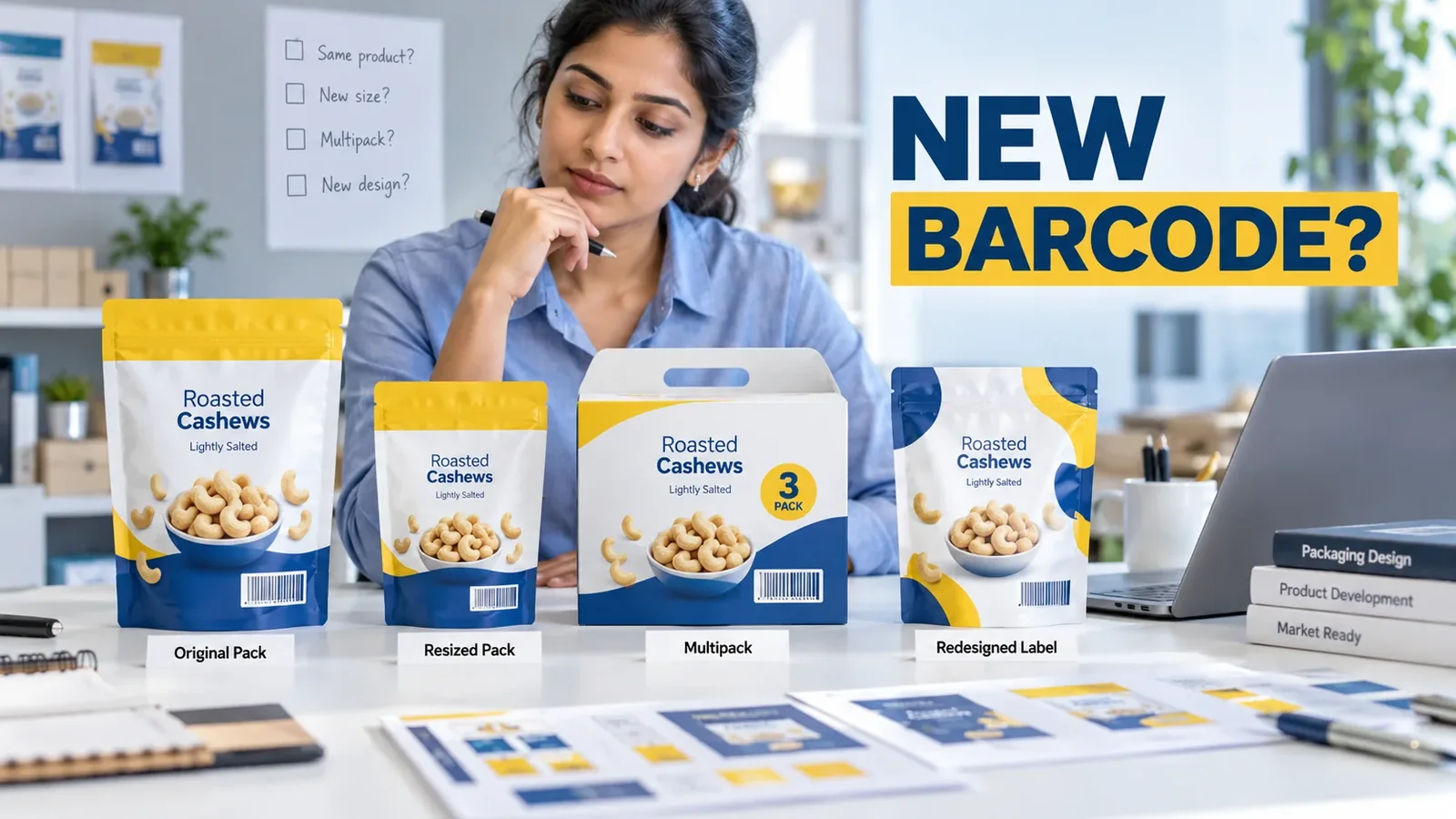
A small packaging update can raise a surprisingly expensive question: should the product keep its existing barcode, or does it now need a new one?
Imagine that your 250 g snack pouch is selling well. You refresh the colours, add a new claim to the front and move the logo. Then you launch a 500 g pouch and a box containing three of the original packs. These changes may appear to belong to one product family, but they do not all have the same effect on ordering, pricing or stock control.
The practical principle is simple: if a change creates a product that customers, retailers or supply-chain systems need to distinguish from the old one, plan for a separate product identifier. A purely visual artwork change may be different—but the commercial meaning of the product matters more than how dramatic the redesign looks.
The Short Answer
You will normally need to assess a new barcode when a product changes in a way that affects what is being sold. Common examples include a new net quantity, flavour, formulation, pack count, bundle or separately sold configuration.
You may be able to retain the existing identifier when the physical product and sellable quantity remain the same and only non-commercial packaging artwork changes. However, do not make that decision from appearance alone. Confirm the current rules of your identification system and the requirements of the retailers, marketplaces or distributors that will receive the product.
Start With the Product, Not the Printed Bars
A retail barcode symbol usually carries a product identifier such as a GTIN. The identifier is what connects a sellable item to records held by your business and its trading partners. Those records may include the product name, variant, quantity, price and inventory status.
This means the real question is not “Does the packaging look different?” It is:
Does the market need to recognise the changed item as a different trade item?
If the answer is yes, reusing the old number can mix two products inside inventory, ordering or reporting systems.
Changes That Usually Need a Separate Barcode
1. A Different Weight, Volume or Count
A 250 g pouch and a 500 g pouch are different sellable items. So are a pack of two and a pack of six. Even when the contents and branding are otherwise identical, the customer receives a different quantity and the retailer normally needs a separate price and stock record.
For example:
- Turmeric Powder — 100 g
- Turmeric Powder — 250 g
- Turmeric Powder — 500 g
These are three separately managed products, not one product with three pouch designs.
2. A New Flavour, Fragrance, Shade or Formulation
Mango and lime pickle, vanilla and chocolate protein powder, or rose and sandalwood soap are distinct variants. The same logic applies to cosmetic shades and product formulations. If each option can be ordered separately, each should be evaluated as its own item.
3. A Multipack, Bundle or Gift Set
A carton containing three retail pouches is not automatically identified by the barcode printed on one pouch. If the outer pack is sold or ordered as one unit, the bundle is a separate trade item and generally needs its own identifier.
This also matters for promotional combinations. A “shampoo + conditioner” gift box is not the same sellable item as either product inside it, even if both inner products already carry barcodes.
4. A Change That Affects How the Product Is Ordered or Priced
If the changed version must have a different listing, purchase order line, price, tax treatment or inventory record, that is a strong signal that a separate identifier may be required. Ask whether a warehouse worker could receive both versions at the same time without confusing them.
5. A Materially Changed Product
A substantial change to the product’s features, purpose or formulation can make it a new trade item even when its name remains familiar. Do not reuse a number simply to avoid changing packaging files. The old identifier may already be connected to product data, reviews, inventory and trading-partner records.
Changes That May Not Require a New Barcode
Some packaging edits do not change the identity of the item being sold. Examples may include:
- adjusting colours, fonts or graphic layout;
- moving the logo without changing the brand itself;
- correcting spelling or punctuation;
- updating contact information; or
- making a minor artwork refresh while the product, declared quantity and sellable configuration remain unchanged.
“May” is important here. A packaging change can look cosmetic while also changing a regulated declaration, brand identity or information relied upon by a trading partner. Check the applicable product-identification rules and channel requirements before retaining the number.
A Decision Table for Common Product Changes
| Product change | Typical decision | Reason to check |
|---|---|---|
| 250 g pack becomes 500 g | Plan a new identifier | Different declared quantity and stock item |
| Original flavour gains a new chocolate flavour | Plan a new identifier | Separately chosen and ordered variant |
| Single unit becomes a pack of three | Plan a new identifier for the multipack | Different sellable configuration |
| Same product gets new colours and typography | Existing identifier may remain | Confirm nothing commercially meaningful changed |
| Logo or brand name changes | Check the applicable standard carefully | Brand identity can affect trade-item identification |
| Limited-edition gift box is sold separately | Plan a new identifier | Separate consumer offer and inventory record |
Can the Old Barcode Be Reused for a Different Product?
Do not take the barcode from a discontinued product and casually assign it to a new one. Product identifiers can remain stored in retailer systems, sales histories, catalogues and customer records long after the old stock has disappeared.
Reusing a number incorrectly can cause the new product to inherit the old product’s name, price, image or stock data. Follow the rules of the issuing or identification system before considering any reuse.
What If Old and New Packaging Will Overlap?
Brands often phase packaging in gradually. A distributor may still hold cartons of the old design while the factory begins shipping the new one.
If the item has not changed in a way that requires a new identifier, old and new artwork may sometimes circulate under the same number during a transition. Your team should still document the change and make sure both symbols scan correctly.
If the product change does require a separate identifier, treat the old and new versions as different items. Record both numbers, effective dates and remaining stock. Do not cover the distinction by printing the old number on the new product.
A Five-Step Check Before Approving New Packaging
- Describe the change precisely. Record what changed in the product, quantity, formulation, brand, package and selling configuration.
- Ask whether both versions can be ordered separately. If yes, they generally need to be distinguished.
- Check the applicable GTIN rules. GS1 maintains a formal GTIN Management Standard for trade-item changes. Use the current standard or the rules of your identifier provider rather than relying on an old blog post.
- Confirm channel requirements. A retailer, distributor or marketplace may have onboarding and product-data requirements beyond whether the number is structurally valid.
- Update your barcode master sheet. Record the product, variant, number, packaging version, assignment date and status before the artwork goes to print.
If you are unsure how many identifiers your complete range needs, use our barcode quantity guide for product variants.
Verify the Number and Test the Printed Pack
There are two different checks to make:
- Number check: Confirm that the 13-digit number has the correct structure and check digit using the YesBarcode verification tool.
- Physical print check: Scan a production-quality sample to catch artwork problems involving size, contrast, distortion, folds, curves, seals or reflective material.
A structurally correct number does not guarantee that a badly printed symbol will scan. Equally, a symbol that scans does not by itself prove that a retailer will accept the identifier route you selected.
Frequently Asked Questions
Do I need a new barcode if I change only the packaging design?
Not necessarily. If only colours, typography or layout change and the product, brand, quantity and sellable configuration remain the same, the existing identifier may remain suitable. Confirm the current identification rules and your trading partner’s requirements.
Does a different pack size need a different barcode?
Yes, separately sold sizes normally need separate identifiers. A 250 g pack and a 500 g pack have different quantities, prices and inventory records.
Does a multipack need its own barcode?
If the multipack is sold, stocked or ordered as one unit, it generally needs an identifier distinct from the individual products inside it.
Can I keep the same barcode after changing the price?
A price change by itself does not always change the product’s identity because price is commonly held in a retailer’s database rather than encoded directly in an EAN-13 symbol. Check the relevant standard and retailer process, especially where the price is printed on the pack.
Can I reuse a barcode from a discontinued product?
Do not reassign it casually. Old identifiers can remain connected to historical product data across retailer and distributor systems. Follow the reuse rules of the issuing system before taking any action.
Where can I get an EAN-13 barcode for a new variant?
First confirm what your intended retailer, marketplace or distributor accepts. If a one-time-purchase EAN-13 option is suitable for those channels, you can review YesBarcode barcode packages, including small-quantity options.
Make the Decision Before the Print Run
A barcode decision is much cheaper to correct in a spreadsheet than on thousands of finished boxes.
Before approving new artwork, define exactly what changed, decide whether the new version must be distinguished in commerce, check the applicable rules and confirm the requirements of your important sales channels. Then assign and record the correct number before your designer creates the final print file.
If you need a new EAN-13 number and have confirmed that YesBarcode’s one-time-purchase route is appropriate for your intended channels, compare the available barcode quantities.