
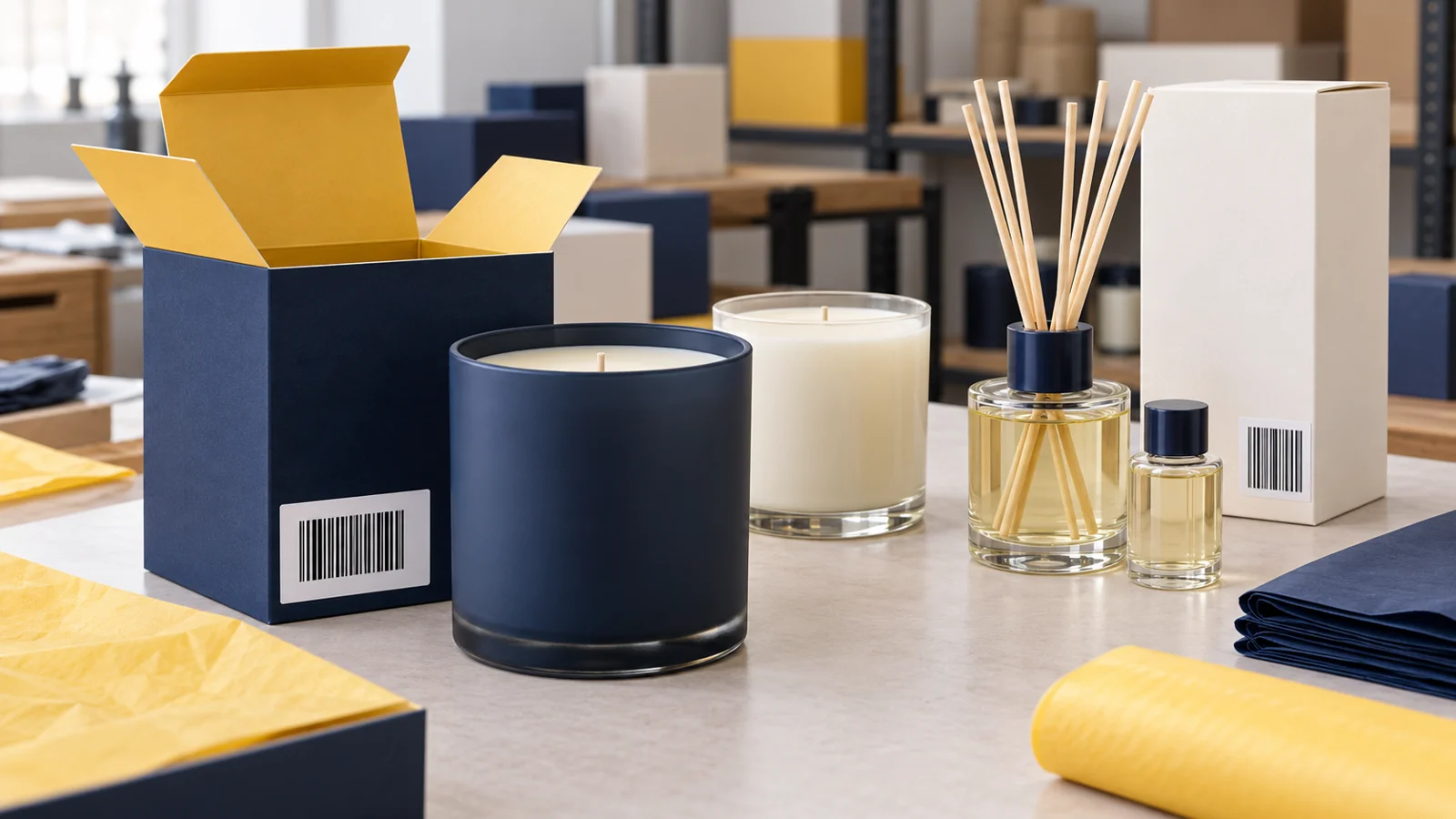
Your candle collection looks ready for launch. There are three fragrances, two jar sizes and a gift box you hope will do well during the festive season. Then a stockist asks for the barcode list.
Do you need one number for the collection, one for each fragrance or a different number on every candle?
Plan a separate product identifier for each distinct retail variant. Identical units of the same variant share that identifier. For candles and home fragrance, the important differences usually include scent, declared quantity, product format and separately sold pack configuration.
This guide helps small brands plan barcodes for candles and home fragrance products in India before ordering labels, cartons or product numbers.
Start With What the Customer Can Order
A collection name is not a complete product description. “Evening Collection” might contain several items that a retailer needs to order and replenish separately.
Write down each sellable combination:
- Vanilla candle, 120 g jar.
- Vanilla candle, 240 g jar.
- Sandalwood candle, 120 g jar.
- Sandalwood candle, 240 g jar.
- Lavender candle, 120 g jar.
- Lavender candle, 240 g jar.
That is six retail variants, even if all six use the same jar style and label design. Producing 100 identical units of each does not turn the requirement into 600 different product numbers.
Count the versions you actually intend to sell. Do not multiply hypothetical sizes and fragrances that are not in your launch range.
Do Different Candle Fragrances Need Different Barcodes?
Separately ordered fragrances should be identified separately. A customer asking for sandalwood should not receive vanilla because both jars share one stock record.
Official product-identification guidance includes fragrance among the distinctions used when assigning item references. Size, weight and presentation can also distinguish products.
Use the exact fragrance name consistently across the pack, barcode register, invoice description and retailer submission. For example, avoid calling the same scent “Lavender” in one file and “Purple Calm” in another unless the relationship is clear.
A decorative colour change is a different question from launching a separately selectable colour variant. Describe what customers and stockists can actually choose rather than assigning numbers for every minor artwork revision.
Jar Size and Wax Quantity Are Not the Same Field
A supplier may describe your container by capacity or external dimensions, while your product label states the candle's net content. Keep these descriptions separate.
Two candles can use similar-looking jars but contain different declared quantities. Conversely, a jar's advertised capacity should not be copied into your candle's weight field.
Use the final approved product specification when assigning identifiers. A change to declared net content needs review under the applicable allocation rules; do not assume the old number remains suitable because the jar still looks familiar.
For a wider explanation of product changes, read when a product needs a new barcode.
Keep Candles, Diffusers, Refills and Wax Melts Separate
A fragrance name can run across a whole home-scent range. That does not make the products interchangeable.
| Product | Example | Catalogue decision |
|---|---|---|
| Jar candle | Vanilla, 120 g | Its own defined retail item |
| Reed diffuser | Vanilla, 100 ml, bottle and reeds | Separate from the candle |
| Diffuser refill | Vanilla, 100 ml, refill only | Separate from the complete diffuser |
| Wax melts | Vanilla, six-piece retail pack | Separate format and pack configuration |
A refill and a complete diffuser may have the same fragrance and liquid quantity, yet the customer receives a different offer. State what is included: bottle, reeds, refill liquid or accessories.
Clear naming also helps fulfilment. “Vanilla 100 ml refill only” is harder to confuse with a complete diffuser than a stock description that says only “Vanilla small”.
Plan Gift Sets Around Their Exact Contents
A fixed physical gift set sold as one retail product needs its own appropriate identifier. Keep it separate from the identifiers of the products inside.
Suppose your range includes the six candle variants listed above, two 100 ml diffuser fragrances and two corresponding refills. That gives you ten individual retail variants. Adding one fixed candle-and-diffuser gift set brings the illustrative total to eleven.
Write the set's composition precisely. “One 120 g vanilla candle plus one 100 ml vanilla diffuser with reeds” is a workable instruction. “One candle and one diffuser, any scent” describes a different arrangement that should be agreed with the buyer.
If you replace an item in a predefined assortment, review a new identifier for the changed set. For the complete assembly and checkout workflow, use the separate guide to barcodes for gift sets and multipacks.
Confirm the Stockist's Requirements Before Buying
Write down the channels you intend to supply: independent gift shops, homeware stores, online marketplaces, distributors or overseas buyers.
Ask each important buyer which product identifiers and registration arrangements it accepts. A code that scans is not a universal acceptance guarantee, and one shop's onboarding process should not be assumed to apply everywhere.
For a new brand, a useful message is: “We are launching candles, diffusers and refills. Please confirm your product-ID requirements and the information you need for each variant.”
Keep the reply with your launch documents. It is easier to resolve a requirement before printing than after a retailer has received your stock.
Build a Barcode List Your Designer Can Use
Make one assignment sheet with a row for each approved product:
- Brand and product name.
- Fragrance.
- Product format.
- Declared quantity and pack count.
- Contents or accessories included.
- Internal SKU and assigned barcode number.
- Approved artwork filename.
- Retailer submission status.
The designer should receive the exact barcode file for the exact item. A visually tidy label with the wrong fragrance's number is still wrong.
Before approving a production run, compare the digits below the symbol with the assignment sheet, then scan a finished sample and check the product record it selects.
Check the Finished Jar, Bottle or Carton
Decide which package the retailer will scan. If the customer buys a boxed candle, test the final boxed product. If the jar itself is the retail unit, test its label after application.
Curves, reflective finishes, seams and handling can affect readability. Involve the printer early and preserve the barcode's required proportions and clear space.
Keep barcode artwork separate from product warnings and other required information. A product identifier does not replace safety testing, instructions or declarations applicable to the product.
For detailed print troubleshooting, use why a barcode may not scan.
How YesBarcode Can Help Your Launch
Once your variant list and channel requirements are confirmed, compare YesBarcode's current EAN-13 packages. Its published offering includes small quantities, JPG and SVG barcode artwork, and an Excel number list.
Use those files to maintain a clear link between the product number and the candle, diffuser, refill or set it identifies. Arrange physical sticker or packaging production with your printer unless separately agreed.
Choose the package around your confirmed catalogue. You need identifiers for distinct products, rather than a new retail number for every identical unit you make.
Frequently Asked Questions
Do handmade candles need barcodes in India?
The practical requirement depends on the sales channel. Ask your retailer, marketplace or distributor which product identifiers it requires before buying numbers or printing labels.
Does each candle fragrance need a different barcode?
If fragrances are separately ordered and sold, identify them separately so the catalogue and fulfilment team can distinguish them.
Can small and large candles share one barcode?
Distinct sizes or declared quantities sold as separate products should have their own appropriate identifiers.
Can a diffuser and its refill share a barcode?
No. A complete diffuser and a separately sold refill are different offers, even when their fragrance and liquid quantity match.
Do I need a different barcode on every identical candle?
No. Identical units of the same defined retail variant share its product identifier. Individual-unit tracking is a separate requirement.
Does a candle gift box need its own identifier?
A fixed physical set sold as one retail product needs an identifier separate from those of its components.
Finalise the Range Before Printing
Put your product list, packaging samples and retailer requirements together. Check that every scent, size, refill and fixed set has a clear identity before approving the labels.
Then choose a suitable YesBarcode package for the confirmed range and give your designer the approved product-to-barcode mapping.