
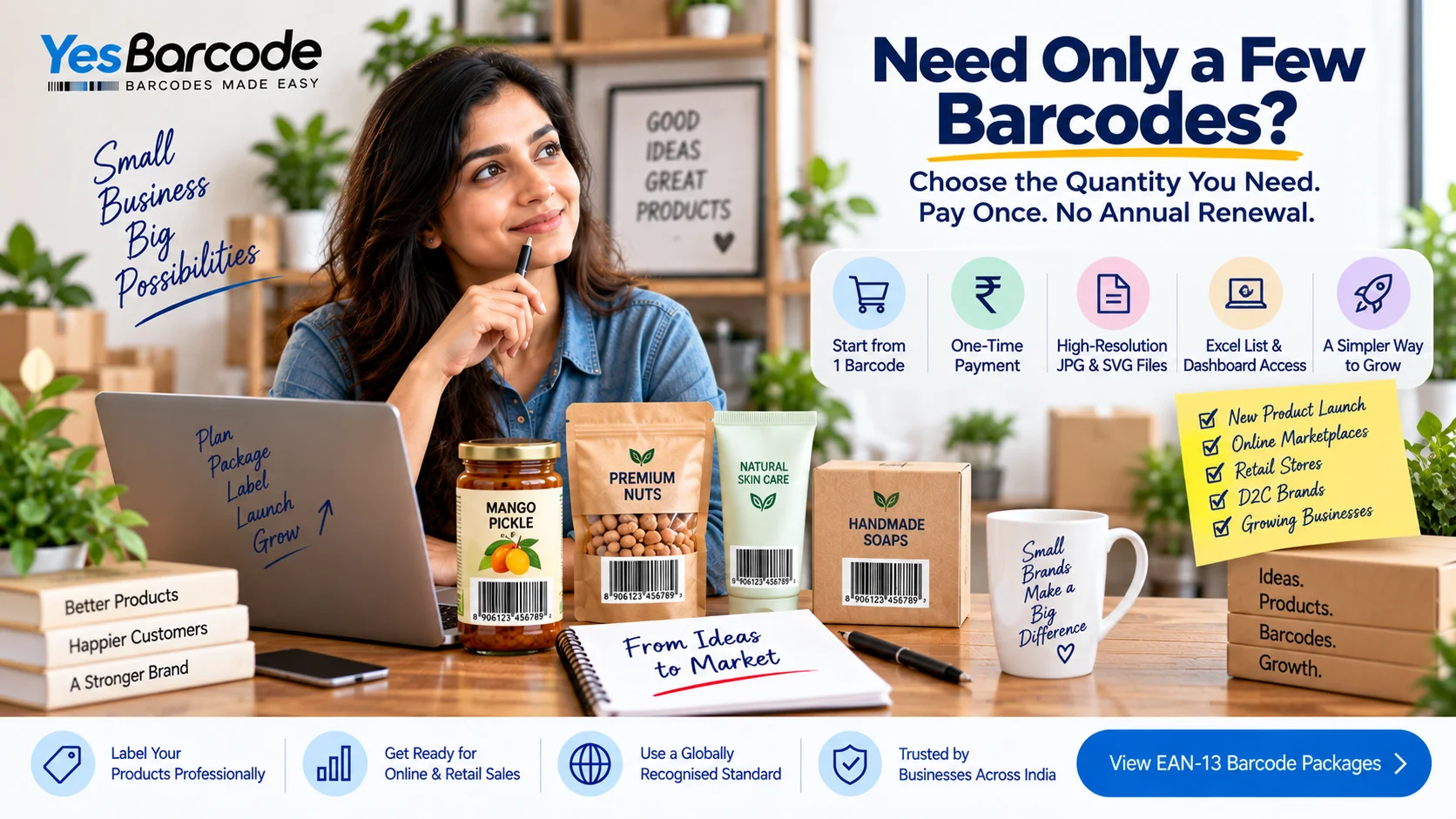
You don't need to be a large manufacturer to need barcodes.
Maybe you are launching three varieties of homemade pickles. Perhaps your skincare brand has four products. You could be introducing your first line of packaged snacks, candles, clothing or household products.
Your products are ready. The packaging design is almost finished. Now you need EAN-13 barcodes.
Then comes the question many small businesses ask:
"I only need a few barcodes. What is the most practical way to get started?"
It is a sensible question.
A business launching five product variants has very different requirements from a manufacturer managing thousands of items. Yet new businesses sometimes choose a barcode solution before working out what they actually need.
A better approach is to start with your products, your sales channels and your expected growth.
Let's work through it.
Start With Your Products, Not the Barcode Package
Before comparing prices or deciding how many EAN-13 barcodes to obtain, make a list of everything you intend to sell.
Not just your product names.
List the individual sellable variants.
Suppose you make mango pickle in two sizes:
- Mango Pickle - 250 g
- Mango Pickle - 500 g
You may think of "Mango Pickle" as one product, but the 250 g and 500 g packs are two different sellable variants.
Now add lime pickle in the same two sizes:
- Lime Pickle - 250 g
- Lime Pickle - 500 g
Your small business now has four sellable variants.
That is the number you should be thinking about when planning your product identifiers.
Why Small Businesses Often Need Only a Few Barcodes
Many businesses begin with a focused product range.
A new skincare company may launch with a face wash, moisturiser and serum. A food entrepreneur might start with four sauces. A candle maker may initially offer three fragrances.
There is nothing unusual about starting small.
In fact, keeping the first range manageable can make product development, packaging, inventory and customer feedback easier to handle.
Your barcode requirement should reflect your actual catalogue rather than the size you hope the business will eventually become.
If you currently have five sellable variants and another three are genuinely planned for launch, plan around those products.
You do not necessarily need to build your barcode requirement around hundreds of hypothetical products that do not yet exist.
What Is an EAN-13 Barcode?
EAN-13 is a widely used retail barcode format consisting of a 13-digit product identifier represented by a machine-readable barcode symbol.
You see these barcodes every day on packaged foods, cosmetics, stationery, clothing, household goods and many other retail products.
In a compatible retail or inventory environment, the barcode can be scanned so the system reads the encoded product number.
The barcode itself may occupy only a small space on your packaging, but assigning identifiers properly becomes increasingly important as your product catalogue grows.
How Many EAN-13 Barcodes Do You Actually Need?
The answer depends on how many separately sold product variants you have.
A useful question is:
If a customer ordered one version and received another, would they consider it the wrong product?
If yes, you are probably dealing with separate variants that need to be distinguished.
Differences can include:
- Size
- Colour
- Weight
- Volume
- Flavour
- Fragrance
- Pack quantity
- Formulation
- Separately sold multipacks
This is why one product idea can quickly turn into several sellable variants.
Example: A Small Food Brand
Imagine you are preparing a new sauce brand.
You have:
- Chilli Sauce - 200 g
- Chilli Sauce - 500 g
- Garlic Sauce - 200 g
- Garlic Sauce - 500 g
That gives you:
2 flavours x 2 sizes = 4 variants
Your immediate requirement is therefore based around four separate sellable products.
Now suppose you know that two additional flavours will launch next month in both sizes.
That would add another four variants.
Instead of planning only for today or buying an unnecessarily large quantity, you could calculate around your current products plus the launches you have genuinely committed to.
Example: A Small Skincare Brand
Consider a skincare startup launching:
- Face Wash - 100 ml
- Face Wash - 200 ml
- Moisturiser - 50 g
- Serum - 30 ml
- Body Wash - 200 ml
That's five sellable variants.
For a founder at this stage, the requirement may be very straightforward:
"I have five products. I need an appropriate identification solution for those five products."
The business can always review its requirements as the catalogue develops.
Example: One Clothing Design Can Create Many Variants
Small quantity does not always mean a small-looking catalogue.
Suppose you sell just one T-shirt design.
It comes in:
- Small
- Medium
- Large
- XL
And three colours:
- Black
- White
- Blue
Your calculation becomes:
4 sizes x 3 colours = 12 variants
So although you might say, "We currently make only one T-shirt," your inventory contains 12 separately sold size-and-colour combinations.
This is why counting variants before purchasing barcodes matters.
Why a One-Time Barcode Purchase Can Appeal to Small Businesses
Running even a small product business involves recurring expenses.
There may be website hosting, accounting software, marketplace charges, payment processing, design tools, advertising, packaging, logistics and other operating costs.
When a business needs only a limited number of EAN-13 barcodes, it is understandable that the owner may prefer a straightforward purchasing model:
Choose the quantity. Pay once. Keep the records. Use the barcodes for the products to which they are assigned.
YesBarcode currently offers its EAN-13 barcode packages using a one-time payment model with no annual renewal fee.
Packages currently start from a single barcode, allowing businesses to choose a quantity according to the size of their product range.
You can view the available quantities on the YesBarcode EAN-13 Barcode Packages page.
What Do You Receive From YesBarcode?
According to the current YesBarcode offering, EAN-13 barcode packages include:
- EAN-13 barcode numbers
- High-resolution JPG barcode files
- Scalable SVG barcode files
- An Excel list of your barcode numbers
- Dashboard access for future downloads
Having both image files and a structured list is useful because different people in your business may need the barcode information for different purposes.
Your packaging designer may need the SVG file.
Your e-commerce team may need the number itself.
Your operations team may need a spreadsheet showing which number belongs to which product.
Keeping those records organised from the beginning becomes increasingly valuable as your catalogue expands.
One-Time Payment Does Not Mean "Suitable Everywhere"
This distinction is important.
A convenient payment model does not automatically determine whether a particular product identifier is appropriate for every retailer, marketplace or supply chain.
Different sales channels can have different product-identification requirements.
Some retailers or marketplaces may require a particular registration, licensing or verification route.
Others may have different catalogue requirements.
So before purchasing barcodes or printing them permanently on thousands of packages, check the current requirements of the places where you intend to sell.
Barcode price should never be the only factor in the decision.
Ask These Questions Before You Buy
A small business can make a much better decision by answering a few questions first.
1. How Many Sellable Variants Do I Have?
Count sizes, colours, flavours, weights, volumes and pack configurations separately where they represent distinct sellable products.
2. Where Am I Going to Sell?
Make a list of your intended channels:
- Online marketplaces
- Your own website
- Local retail stores
- Supermarkets
- Distributors
- Wholesalers
- Export customers
3. What Does Each Sales Channel Require?
Check the current requirements directly with the marketplace, retailer, distributor or trading partner where necessary.
Do this before mass-printing your packaging.
4. How Much Will My Catalogue Grow?
Think about realistic launches over the next few months.
If you have five products today and another five are already being manufactured, it makes sense to include them in your planning.
If you simply hope to have 500 products one day, there is no need to treat all 500 as an immediate requirement.
5. Do I Prefer One-Time or Recurring Costs?
If the barcode solution appropriate for your intended use offers a one-time purchasing model, you may prefer knowing the cost upfront rather than adding another recurring expense to your business.
Small Quantity Does Not Mean Small Ambition
There is sometimes a tendency to think that a professional product business needs to start big.
It doesn't.
Many brands begin by getting a handful of products right.
Good packaging. Reliable manufacturing. Clear product information. Consistent quality. Proper inventory records. Happy customers.
Then they expand.
If you are launching four products today, your immediate objective is not to look like a company with 4,000 products.
It is to organise those four products properly.
That includes assigning product identifiers carefully and maintaining accurate records from the beginning.
Create a Barcode Master Sheet From Day One
Even if you have only three products, start a barcode master sheet.
It can be extremely simple:
| Product | Variant | SKU | EAN-13 | Status |
|---|---|---|---|---|
| Mango Pickle | 250 g | MP250 | Assigned Number | Active |
| Mango Pickle | 500 g | MP500 | Assigned Number | Active |
| Lime Pickle | 250 g | LP250 | Assigned Number | Active |
As the business grows, you can add:
- Date assigned
- Product category
- Packaging version
- Marketplace status
- Launch date
- Internal notes
The objective is to make sure everybody knows which identifier belongs to which product.
Don't Print Thousands of Labels Without Testing First
Getting the number is only one part of the job.
The barcode also needs to work properly when printed.
Before approving a large packaging run, check for common problems such as:
- Barcode artwork being stretched or distorted
- Insufficient clear space around the barcode
- Poor contrast between the bars and background
- Barcode dimensions being reduced excessively
- Low-resolution artwork
- Poor printing on the actual packaging material
Print a physical sample and test it before mass production.
A small packaging test can save a much larger reprinting bill later.
EAN-13 Barcode or Dynamic QR Code?
Small businesses sometimes assume that a QR code can simply replace a retail product barcode.
They serve different purposes.
An EAN-13 barcode is primarily used for product identification in compatible retail and inventory environments.
A Dynamic QR Code can connect a customer using a smartphone to digital content such as:
- A product page
- Instructions
- A digital catalogue
- A menu
- A promotional page
- A feedback form
- A PDF
- Social media content
A dynamic QR solution can also allow the destination to be updated later without replacing the already printed QR code.
For businesses that need this functionality, you can explore YesBarcode Dynamic QR Codes.
Can You Put an EAN-13 Barcode and QR Code on the Same Product?
Yes. In suitable situations, they can complement each other.
For example, a food brand could use an EAN-13 barcode for product identification and a Dynamic QR Code to send customers to recipes or detailed product information.
A skincare brand might use the EAN-13 for product identification while a QR code opens usage instructions or additional online information.
The key is to give each code a clear purpose rather than adding technology to the packaging simply because it is available.
A Practical Example: From Kitchen Table to Retail Shelf
Imagine you have been selling homemade sauces directly to customers.
Demand grows, and a few local retailers want to stock your products.
You decide to launch:
- Chilli Sauce - 200 g
- Chilli Sauce - 500 g
- Garlic Sauce - 200 g
- Garlic Sauce - 500 g
- Mint Sauce - 200 g
You now have five separately sold variants.
A sensible process would be:
- Confirm the five product variants.
- Check the identification requirements of the retailers where you intend to sell.
- Select an appropriate barcode solution.
- Assign one identifier to each applicable product variant.
- Record the assignments in your master sheet.
- Add the barcode artwork to your packaging.
- Print and test a sample.
- Only then approve the full packaging run.
That is a professional barcode process.
It doesn't require the business to pretend it is larger than it is. It simply requires planning.
Why Flexible Quantities Can Help a Growing Brand
For a growing business, flexibility can be more useful than buying according to an imagined future.
You might need one barcode for your first product.
Another business may need five.
A growing catalogue may need 25, 50, 100 or more.
YesBarcode currently provides EAN-13 packages across different quantities so businesses can select an option according to their catalogue requirements.
The current packages and pricing can be viewed on the EAN-13 Barcode Packages page.
Frequently Asked Questions
Can I buy just one EAN-13 barcode?
YesBarcode currently offers an EAN-13 option starting from a single barcode. Before purchasing, make sure the identifier is suitable for the retailer, marketplace or other sales channel where you intend to use it.
Do I have to buy hundreds of barcodes for a small business?
Not necessarily. Your requirement should be based on your sellable product variants and the requirements of your sales channels. A business with only a few products may need only a small quantity.
Does YesBarcode charge annual renewal fees for EAN-13 barcodes?
According to the current YesBarcode offering, its EAN-13 packages use a one-time payment model with no annual renewal fee.
How do I calculate how many barcodes I need?
Count separately sold product variants. Different sizes, colours, flavours, weights, volumes and pack quantities can increase your requirement.
Does every size need a separate barcode?
If the sizes are separately sold trade items, they should generally be treated separately when planning product identification. For example, a 250 g package and a 500 g package are different sellable variants.
Can I use the same barcode for different flavours?
Separately sold flavours should be treated as different product variants. Assigning the same product identifier to different products can create confusion in inventory and retail systems.
Should I check with my retailer before purchasing?
Yes. Retailers, marketplaces and trading partners can have their own product-identification requirements. Check the applicable requirements before purchasing barcodes or printing packaging in large quantities.
Is a QR code the same as an EAN-13 barcode?
No. EAN-13 is primarily used for product identification in compatible retail and inventory environments. A QR code is commonly used to connect users to digital information or online destinations.
What files does YesBarcode provide?
According to the current YesBarcode EAN-13 offering, customers receive barcode numbers along with high-resolution JPG and SVG files and an Excel list, with dashboard access for future downloads.
Final Thoughts
If you only need a few barcodes, don't make the decision more complicated than it needs to be.
Start by counting your products properly.
Then check where you intend to sell and what those channels require.
Once you know that, you can choose an appropriate product-identification solution and a quantity that reflects the size of your actual catalogue.
For businesses whose intended use is suitable for the YesBarcode offering, the ability to start with a small quantity and make a one-time purchase without annual renewal fees can provide a straightforward way to get started.
Start with what you need today. Keep your records organised. Build the system as your product range grows.
Need EAN-13 Barcodes for Your Products?
YesBarcode offers EAN-13 barcode packages starting from a single barcode, with larger quantities available for growing product catalogues.
Already have an EAN-13 number you want to check?
Need an editable digital destination for your packaging or marketing material?