
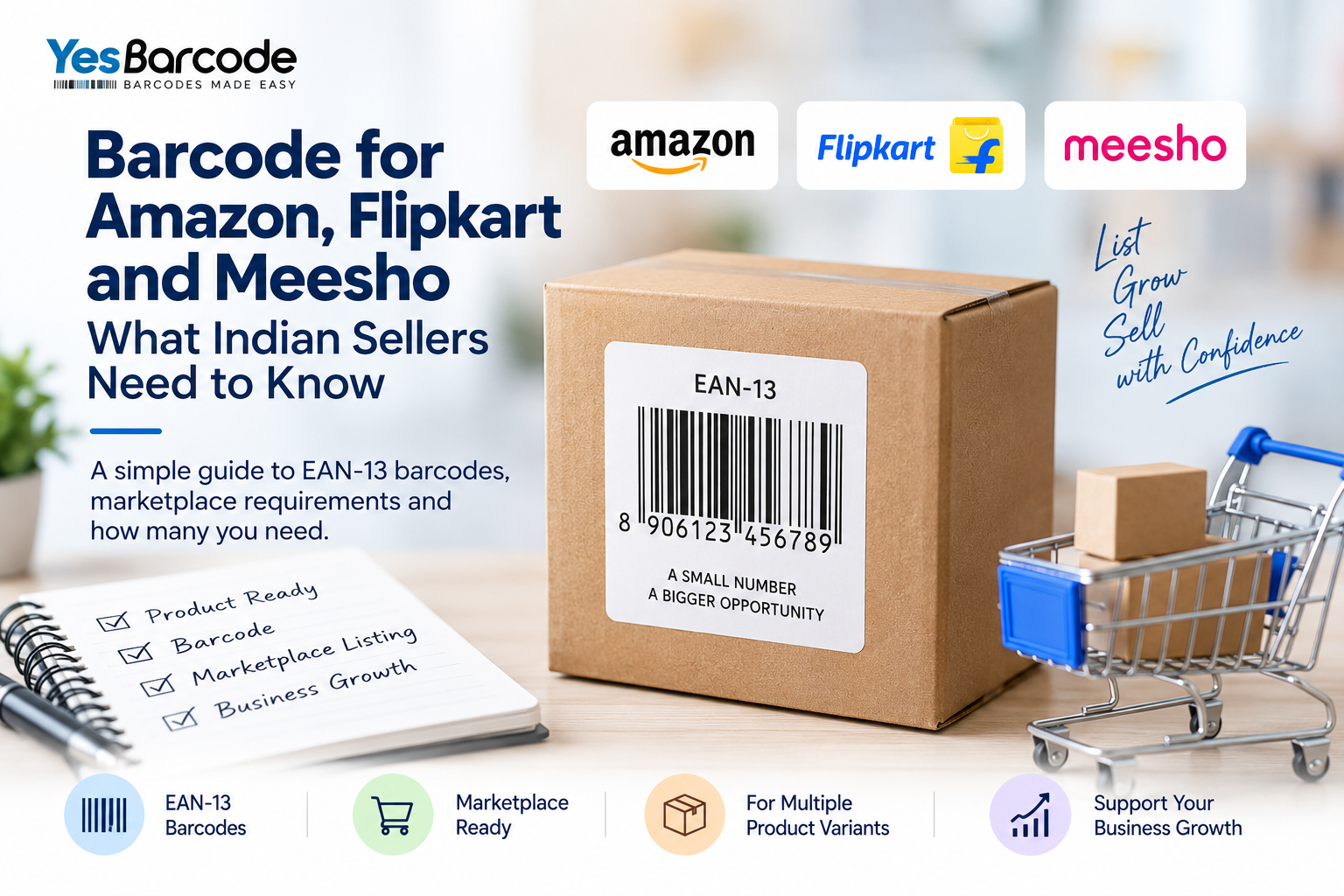
Launching a product online should be straightforward. Your product is ready, the packaging looks good, photographs have been taken and the price is final.
Then you start creating the listing.
Suddenly, the marketplace asks for a Product ID, EAN, GTIN or barcode.
For a first-time seller, this is often where things become confusing.
Do Amazon and Flipkart need different barcodes? Does every size need its own number? What happens when the same product is available in five colours? Can you simply create a barcode online and use it?
These are practical questions. Getting the answers right before printing your packaging can save a great deal of time, money and unnecessary rework later.
Let's make the process easier to understand.
What Is an EAN-13 Barcode?
An EAN-13 barcode is the familiar retail barcode you see on everyday packaged products. It consists of a machine-readable pattern representing a 13-digit number.
You have probably seen EAN-13 barcodes thousands of times without giving them much thought. They appear on packaged foods, cosmetics, clothing, stationery, household products and many other items sold through retail channels.
When the barcode is scanned at a billing counter, warehouse or compatible inventory system, the scanner reads the number encoded in the symbol.
For businesses selling consumer products in India and many other markets, EAN-13 is one of the most commonly encountered retail barcode formats.
The important point is that a barcode is not simply a graphic added to make packaging look retail-ready. It forms part of a product-identification system.
Barcode, EAN and GTIN: Are They the Same Thing?
These terms are often used interchangeably in everyday business conversations, but they do not mean exactly the same thing.
GTIN stands for Global Trade Item Number. It refers to an identification number for a trade item within the GS1 system.
EAN-13 is a widely used retail barcode format associated with a 13-digit product identifier.
The barcode symbol is the machine-readable representation of the number.
A simple way to remember the distinction is:
- The number identifies the trade item.
- The barcode allows a scanner to read that number.
This distinction becomes particularly important when selling through online marketplaces. Creating a barcode image does not, by itself, guarantee that the underlying product identifier meets a marketplace's requirements.
Why Do Online Marketplaces Ask for Product Identifiers?
Think about the size of an online marketplace. Thousands of sellers may be offering similar products, and each seller can describe those products differently.
One seller might call a product "Organic Mango Pickle 500 g", while another might write "Premium Mango Pickle - 500GM".
Product names alone are therefore not an ideal way to organise a large catalogue.
Product identifiers help marketplaces, retailers, warehouses and inventory systems distinguish trade items more consistently. That is why, while creating a listing, sellers may encounter terms such as:
- EAN
- GTIN
- UPC
- ISBN
- Product ID
- Barcode
Which identifier is required depends on the product, category and sales channel.
Do You Need an EAN-13 Barcode for Amazon India?
Amazon requires product identifiers for many products and categories, although some products may qualify for an exemption.
When creating a new product listing, Amazon may ask for a Product ID such as a GTIN, EAN or another accepted identifier depending on the category.
There is an important consideration for Amazon sellers: Amazon may verify product identifiers against GS1 information.
That means sellers should not assume that any 13-digit number capable of producing a scannable barcode will automatically satisfy Amazon's listing requirements.
If Amazon is going to be an important sales channel for your business, check the latest requirements for your particular product, brand and category before purchasing barcode numbers or printing them permanently on packaging.
This is especially important when you are preparing a large packaging run. Verifying the requirements before printing is considerably easier than correcting thousands of finished boxes, labels or pouches later.
What Is an Amazon GTIN Exemption?
Some products that do not have a standard product identifier may qualify for a GTIN exemption on Amazon.
Eligibility can depend on factors such as the product category and brand situation. A GTIN exemption and an EAN-13 barcode are therefore not the same solution.
If your product qualifies for an exemption, Amazon may allow you to create the listing without the standard Product ID normally requested for that category.
Because marketplace policies can change, sellers should always check the current requirements shown in their Seller Central account rather than relying on an old article, forum post or another seller's experience.
Do You Need an EAN-13 Barcode for Flipkart?
Flipkart also uses structured product information to organise its catalogue, and listing requirements can differ between categories.
The practical approach is to check the requirements displayed for your specific category while preparing the listing.
Do not assume that because a product identifier was accepted by one marketplace, every other marketplace will follow exactly the same process.
This becomes especially important for brands planning to sell the same catalogue through several online and offline channels.
What About Meesho and Other Indian Marketplaces?
Meesho and other e-commerce platforms can have their own catalogue and product-identification requirements, which may vary according to the type of product being sold.
Before finalising your packaging, make a simple list of all the channels where you realistically intend to sell:
- Amazon
- Flipkart
- Meesho
- JioMart
- Your own website
- Physical retailers
- Distributors and wholesalers
- Export customers
Then check the product-identification requirements that apply to those channels.
A few minutes of planning at this stage can prevent unnecessary relabelling and catalogue work later.
Do You Need a Different Barcode for Amazon and Flipkart?
Normally, a product identifier identifies the trade item, rather than the marketplace where that item is sold.
So you would not normally create a completely different product identity simply because the same product is being offered through another compatible sales channel.
However, there is an important distinction:
The product may remain the same, but individual marketplaces can have different rules about which identifiers they accept and how those identifiers are verified.
Always check the current marketplace requirements before creating or changing a listing.
How Many EAN-13 Barcodes Does Your Business Need?
This is one of the most common areas of confusion for new brands.
The easiest mistake is to count product names rather than sellable product variants.
Consider a T-shirt available in four sizes:
- Small
- Medium
- Large
- Extra Large
Now suppose the same T-shirt is available in three colours:
- Black
- White
- Blue
The calculation is:
4 sizes x 3 colours = 12 sellable variants
If every size-and-colour combination is independently sold, you would generally plan for 12 separate product identifiers.
The same principle applies to food, cosmetics, apparel, supplements, stationery and many other product categories.
Example: Food Products
Imagine a company selling three flavours of pickle:
- Mango
- Lime
- Mixed
Each flavour is available in two sizes:
- 250 g
- 500 g
Your calculation becomes:
3 flavours x 2 sizes = 6 sellable variants
The 250 g mango pickle and 500 g mango pickle are different trade items from a customer's and retailer's perspective.
Example: Cosmetics
Suppose your company sells a face wash in two sizes:
- 100 ml
- 200 ml
These are separately sold variants.
Now imagine that your company also launches body wash in three fragrances, with each fragrance available in two sizes.
That gives:
3 fragrances x 2 sizes = 6 body-wash variants
Counting the complete catalogue before purchasing identifiers helps you estimate your actual requirement much more accurately.
Example: Clothing
Apparel businesses can require large numbers of identifiers surprisingly quickly.
Suppose a clothing brand launches:
- 5 shirt designs
- 4 sizes
- 3 colours
The calculation becomes:
5 designs x 4 sizes x 3 colours = 60 sellable variants
The business owner may think, "We sell five shirt designs."
From a product-identification and inventory perspective, however, there are 60 separate combinations.
Does Every Colour Need a Different Barcode?
If each colour is sold as a distinct variant, it should generally be treated separately for product identification.
A useful practical question is:
If a customer ordered one version and received the other, would they consider it the wrong product?
If the answer is yes, you are probably dealing with separately identifiable trade items.
The same principle commonly applies to differences such as:
- Size
- Colour
- Flavour
- Fragrance
- Weight
- Volume
- Pack quantity
- Formulation
- Separately sold multipacks
Does a Multipack Need Its Own Barcode?
Consider a snack company selling one packet individually and also selling a pack containing six of those packets as a separate retail product.
The single packet and the six-pack are different trade items.
The retail multipack may therefore require its own identifier when it is independently sold, stocked and scanned.
This is another reason to map your complete product range before deciding how many barcode numbers you require.
Can You Generate an EAN-13 Barcode Online for Free?
There are many online tools capable of generating a barcode image from a sequence of digits.
But creating the barcode image is not the same as obtaining an appropriate product identifier.
A barcode generator simply converts the digits supplied to it into a machine-readable graphical pattern.
It does not automatically establish:
- Where the number originated
- Whether it has previously been assigned
- Whether you have the right to use it
- Whether it is unique to your product
- Whether your intended marketplace will accept it
That distinction matters when a number is going to become part of commercial packaging.
What Should You Check Before Getting EAN-13 Barcodes?
A little planning before purchasing and assigning identifiers can save considerable work later.
1. Decide Where You Intend to Sell
Will you sell through Amazon, Flipkart, Meesho, your own website, physical stores, distributors or export customers?
Your intended channels can influence which product-identification solution is appropriate.
2. Count Every Sellable Variant
Create a list of every size, colour, flavour, weight, volume and pack configuration you intend to sell independently.
Do not estimate if you can avoid it. A simple spreadsheet is enough to calculate the requirement properly.
3. Check Marketplace Requirements
If a marketplace is central to your business, check its current product-ID requirements before purchasing identifiers or printing packaging.
4. Maintain Clear Product Assignments
Once a number is assigned to a product, record that relationship clearly so another team member does not accidentally assign the same number elsewhere.
5. Keep Your Original Files and Records
Your packaging designer may need a high-quality barcode file, while your marketplace or inventory team may need the number in spreadsheet format.
Keep all the original files and records in a location accessible to the people responsible for your product catalogue.
If EAN-13 barcodes are appropriate for your intended use, you can view YesBarcode's available quantities on the Buy EAN-13 Barcodes page.
Test Your Barcode Before Printing Thousands of Packages
This is one of the simplest precautions a brand can take.
Even when the underlying number is correct, poor packaging design or printing can make a barcode difficult to scan.
Common problems include:
- Stretching or distorting the barcode
- Reducing it excessively
- Cropping the clear space around the symbol
- Using poor colour contrast
- Placing it over a complicated background
- Using low-resolution artwork
- Poor print quality on the final packaging material
Before approving a large packaging order, print a sample using the actual packaging material, printing method and approximate dimensions you intend to use commercially.
Then test it with appropriate scanning equipment.
A small test before mass production can be far cheaper than discovering a scanning problem after thousands of units have already been printed.
Keep a Barcode Master Sheet
Once your business has more than a handful of products, maintain one central record of every barcode assignment.
Your master sheet can contain fields such as:
| EAN-13 | Product | Variant | SKU | Status |
|---|---|---|---|---|
| Assigned Number | Mango Pickle | 250 g | MP250 | Active |
| Assigned Number | Mango Pickle | 500 g | MP500 | Active |
| Assigned Number | Mango Pickle | 1 kg | MP1000 | Active |
The exact spreadsheet format is not important.
What matters is having one reliable record that your packaging, warehouse, sales and e-commerce teams can refer to.
This reduces the risk of two people accidentally assigning the same number to different products.
EAN-13 Barcode vs Dynamic QR Code: What's the Difference?
EAN-13 barcodes and Dynamic QR Codes are sometimes placed on the same packaging, but they perform different jobs.
An EAN-13 barcode is primarily associated with product identification in retail and inventory environments.
A Dynamic QR Code is useful when you want a customer to scan a code with a smartphone and reach digital content.
For example, a Dynamic QR Code can direct customers to:
- A product-information page
- A digital catalogue
- A restaurant menu
- A user manual
- A promotional landing page
- A feedback form
- A social media page
- Other online content
One of the useful features of a dynamic QR solution is that the destination behind the code can be updated later without necessarily replacing the QR code already printed on the material.
This can be valuable for packaging, brochures, menus and marketing materials that may remain in circulation while the online destination changes.
If that is what your business needs, you can explore YesBarcode Dynamic QR Codes.
Can You Use an EAN-13 Barcode and Dynamic QR Code Together?
Yes. In many situations, using both makes sense because they solve different problems.
For example, a packaged-food business might use:
- EAN-13: for product identification within compatible retail and inventory systems.
- Dynamic QR Code: to take customers to recipes, product information, promotional content or another online resource.
A cosmetics brand could use a Dynamic QR Code for usage instructions, ingredients information or a product page while retaining its EAN-13 for product identification.
Instead of asking which technology is better, ask what job you need each code to perform.
A Simple Checklist Before Listing Your Product
Before publishing your first marketplace listing or approving your packaging, check the following:
- Have you counted every sellable product variant?
- Have you checked the requirements of your intended marketplace or retailer?
- Does every required variant have its appropriate identifier?
- Have you recorded each assignment in a central master sheet?
- Is your product and brand information consistent across your records?
- Has the barcode been placed correctly in the packaging artwork?
- Have you tested a physical print before mass production?
- Have you stored your original barcode files and records safely?
Following a structured process at the beginning makes expanding your catalogue much easier later.
Frequently Asked Questions
What barcode is commonly used for retail products in India?
EAN-13 is one of the most commonly encountered retail barcode formats in India and many other international markets. It uses a 13-digit product identifier represented in a machine-readable barcode symbol.
Do I need a different barcode for Amazon and Flipkart?
A product identifier normally identifies the trade item rather than a particular marketplace. However, marketplaces can have different rules concerning which identifiers they accept and how they verify them. Always check the current requirements of each platform before listing.
Does every product size need a different EAN-13 barcode?
If different sizes are sold as separate trade items, they should generally be identified separately. For example, a 250 g pack and a 500 g pack are different sellable variants.
Does every colour need its own barcode?
If colours are sold as separate variants, they should generally be treated as separately identifiable trade items.
Can I generate an EAN-13 barcode online for free?
A barcode generator can create the graphical barcode from a number. It does not automatically establish the origin, uniqueness, rights of use or marketplace suitability of the underlying number.
How many barcodes does my business need?
Count your separately sold product variants rather than simply counting product names. Differences such as size, colour, flavour, weight, volume and pack configuration can increase the number of identifiers you require.
What is the difference between an EAN-13 barcode and a Dynamic QR Code?
EAN-13 is primarily associated with product identification in retail and inventory applications. A Dynamic QR Code connects a user to digital content and can allow the destination behind the printed code to be updated later.
Can I put both an EAN-13 barcode and a QR code on my packaging?
Yes. They can serve different purposes. An EAN-13 can identify the trade item, while a Dynamic QR Code can connect customers to online product information, instructions, promotions or other digital content.
Where can I buy EAN-13 barcodes?
YesBarcode provides EAN-13 barcode packages for different catalogue sizes. Before purchasing, make sure the product identifiers you choose are appropriate for your intended marketplace, retailer or other sales channel. You can view the available options on the YesBarcode EAN-13 Barcode page.
Final Thoughts
A barcode occupies only a small area of your packaging, but it can play an important role in how your product is identified and managed.
The best time to organise product identification is before you begin mass printing.
Start by identifying where you intend to sell. Then count every product variant carefully, check the requirements of your marketplaces and retailers, assign numbers systematically and maintain a central record.
Most importantly, don't confuse generating a barcode image with choosing an appropriate product identifier.
If your requirements are suitable for YesBarcode's EAN-13 service, you can compare the available quantities on the Buy EAN-13 Barcodes page.
Need EAN-13 Barcodes for Your Products?
Whether you're preparing your first product for sale or adding new variants to an established catalogue, calculate your requirements before purchasing.
YesBarcode offers EAN-13 barcode packages for different product requirements.
Already have an EAN-13 number you want to check?
Need a QR code whose destination can be updated after the code has been created?